
Behavioral health providers often focus on denied claims because denials are visible and require immediate attention. Underpayments are different. A claim may be processed as paid, appear closed in the billing system, and still have reimbursed less than the amount the payer was contractually required to pay.
This makes underpayments particularly difficult to detect.
A behavioral health practice can submit a clean claim, receive an explanation of benefits, post the payment, and move on without realizing that the payer has reimbursed below the contracted rate. When this happens repeatedly across therapy sessions, psychiatric services, psychological testing, intensive outpatient programs, or other behavioral health services, the financial impact can become substantial.
Underpayment recovery does not have to depend on manually reviewing every claim. With a structured process, billing teams can identify payment variances, determine whether the payer’s calculation is correct, document the discrepancy, and pursue additional reimbursement.
What Is a Payer Underpayment?
A payer underpayment occurs when an insurer reimburses a behavioral health provider for less than the amount the provider is contractually entitled to receive, assuming the claim was processed according to the applicable agreement and payment rules.
The basic comparison is:
Expected allowed amount – Actual allowed amount = Potential underpayment
For example, suppose a behavioral health provider’s payer contract establishes an allowed amount of $120 for a particular covered service.
The claim is processed and the explanation of benefits shows:
- Billed charge: $160
- Contracted allowed amount: $120
- Insurance payment: $96
- Patient responsibility: $24
At first glance, the claim may appear correctly paid.
But if the contract says the payer should allow $120 and pay 90% of that amount, the expected insurance payment would be:
$120 × 90% = $108
The actual payment is $96.
Therefore:
$108 expected payment – $96 actual payment = $12 potential underpayment
One claim may not seem significant. But if the same discrepancy occurs on 300 claims, the potential variance becomes:
300 × $12 = $3,600
This is why underpayment management is fundamentally a pattern-recognition problem.
Why Behavioral Health Underpayments Can Be Difficult to Detect
Behavioral health billing has several characteristics that can make payment variance analysis complicated.
Multiple service types
A behavioral health organization may bill for:
- Psychotherapy
- Psychiatric evaluation
- Medication management
- Psychological testing
- Family therapy
- Group therapy
- Crisis services
- Telebehavioral health
- Intensive outpatient services
- Partial hospitalization services
- Case management or care coordination where covered
- Other specialized behavioral health services
Each service may have different reimbursement terms.
Multiple payer contracts
A practice may participate with several commercial insurers, Medicare, Medicaid programs, Medicare Advantage plans, employer-sponsored plans, and other networks.
The expected payment for the same CPT or HCPCS code may therefore differ between contracts.
Different provider credentials
The reimbursement methodology may also vary according to provider type, credential, specialty, location, or network status.
For example, a contract may distinguish between services provided by:
- Psychiatrists
- Psychologists
- Licensed clinical social workers
- Licensed professional counselors
- Other qualified behavioral health professionals
The billing team therefore cannot assume that one payment rule applies to every behavioral health claim.
Complex claim adjustments
A payment may also be affected by:
- Deductibles
- Coinsurance
- Copayments
- Multiple procedure rules
- Bundling
- Modifier processing
- Telehealth rules
- Coordination of benefits
- Authorization requirements
- Contractual adjustments
- Payer-specific reimbursement policies
This is why a payment that appears lower than the billed charge is not automatically an underpayment.
The key question is:
Was the payer’s final allowed amount and payment calculation consistent with the applicable contract and claim circumstances?
Identify and Recover Payer Underpayments
Start With the Contract, Not the Payment
One of the most important steps in underpayment recovery is determining the correct expected reimbursement.
A billing team cannot reliably identify an underpayment simply by comparing the payer’s payment with the provider’s billed charge.
The billed charge is often not the amount the payer is obligated to reimburse.
Instead, the team needs to understand the applicable contractual rate.
Create a contract reference containing information such as:
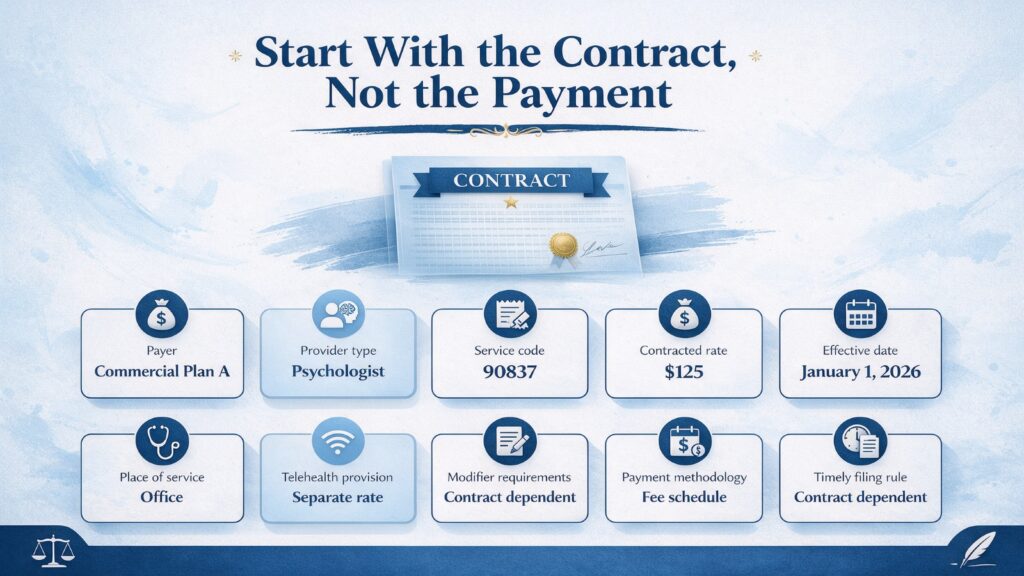
The exact fields will vary by organization.
The purpose is to create a reliable source against which actual payments can be compared.
| Important considerationContracts can change.A rate that was correct last year may not be correct today. A payer may also issue an amendment, fee schedule update, or revised reimbursement provision. |
For this reason, every expected-payment calculation should consider the date of service and the contract version that applied on that date.
Build a Payment Variance Workflow
A practical underpayment process can be organized into five stages:
- Claim paid
- Payment compared with expected reimbursement
- Variance investigated
- Underpayment documented
- Recovery pursued
Each stage has a different purpose.
Stage 1: Identify paid claims
Start with claims that the payer has processed and paid.
This can include claims from:
- Your practice management system
- Electronic remittance advice
- Paper explanations of benefits
- Clearinghouse reports
- Payer portals
Stage 2: Calculate expected reimbursement
Compare the actual payment against the applicable contracted amount.
Stage 3: Investigate the variance
Determine whether the difference has a legitimate explanation.
Stage 4: Document confirmed underpayments
Record the evidence supporting the expected amount.
Stage 5: Submit the recovery request
Depending on the payer and circumstances, this may involve:
- Reconsideration
- Payment dispute
- Corrected claim
- Formal appeal
- Contractual dispute process
- Payer escalation
- Other available recovery mechanisms
The exact process depends on the payer, contract, claim status, and applicable rules.
Create an Underpayment Detection Spreadsheet
A spreadsheet can be an effective starting point for a smaller behavioral health practice.
Useful columns include:
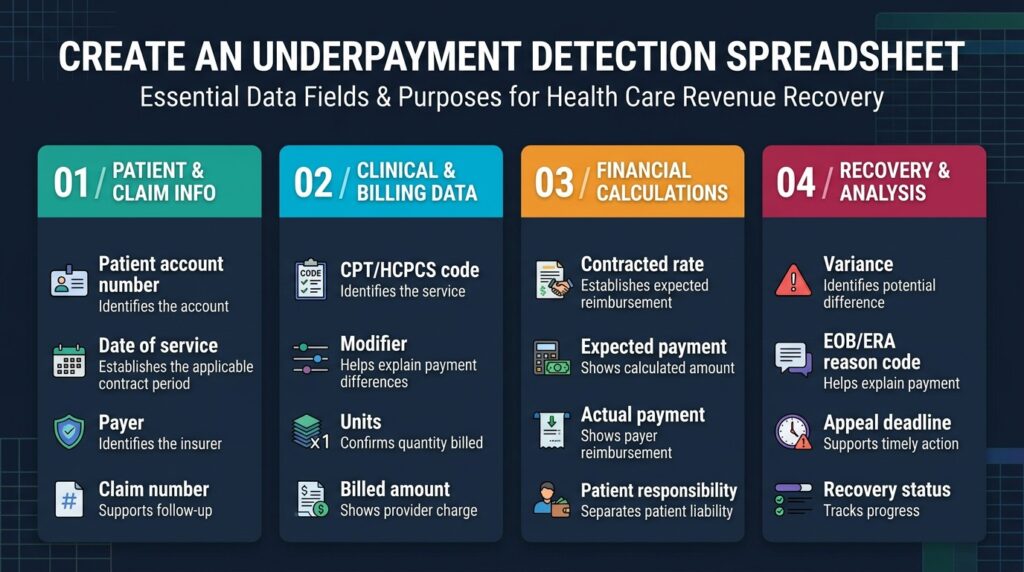
A simple variance calculation can be:
Expected provider reimbursement – Actual provider reimbursement = Variance
However, do not treat every positive variance as a confirmed underpayment.
It should initially be classified as a potential variance until the payment explanation has been reviewed.
Distinguish Underpayments from Legitimate Payment Differences
This is one of the most important controls in the process.
A lower payment does not automatically mean the payer made an error.
Consider a psychotherapy claim with:
- Contracted allowed amount: $150
- Insurance payment: $90
- Patient coinsurance: $60
The payer may have correctly processed the claim.
The provider should therefore analyze the complete adjudication rather than looking only at the check or EFT amount.
Review these questions
- What was the contractual allowed amount?
- What amount did the payer recognize as allowable?
- How much was assigned to patient responsibility?
- Was the deductible applied?
- Was coinsurance applied?
- Was a copayment applied?
- Were multiple services billed on the same date?
- Were services bundled?
- Was a modifier recognized?
- Was the claim processed under the correct network status?
- Was the correct provider type used?
- Was the correct place of service used?
- Was another insurer involved?
- Was the claim subject to a special reimbursement methodology?
Only after these questions have been answered should the billing team classify the variance as a potential payer underpayment.
Compare the EOB or ERA With the Contract
The explanation of benefits or electronic remittance advice provides important clues.
Look beyond the final payment amount.
Review:
- Allowed amount
- Paid amount
- Patient responsibility
- Adjustment codes
- Remark codes
- Claim status
- Service-line information
- Units
- Procedure codes
- Modifiers
- Provider information
For electronic remittance advice, adjustment and remark codes can help explain why the payer reduced or changed the reimbursement.
The key is to connect the remittance information with the contract.
For example:
- Contract says: $140 allowed
- Payer EOB says: $115 allowed
- Difference: $25
The next question is not automatically “Why did the payer underpay?”
Instead ask:
What contractual or claim-processing rule explains the $25 difference?
If no valid explanation can be identified, the claim becomes a stronger underpayment candidate.
Use Service-Level Analysis Instead of Only Claim-Level Analysis
A single claim can contain multiple service lines.
For example:
| Service | Contracted amount | Payer allowed | Variance |
| 90837 | $150 | $150 | $0 |
| 90834 | $120 | $105 | $15 |
| 90792 | $210 | $190 | $20 |
If the billing team looks only at the total claim payment, these individual differences can be difficult to identify.
Service-line analysis makes patterns easier to see.
This becomes particularly valuable when the same CPT code repeatedly produces a similar variance.
For example:
90837
- Claim 1: $15 variance
- Claim 2: $15 variance
- Claim 3: $15 variance
- Claim 4: $15 variance
- Claim 5: $15 variance
Five claims suggest a possible systematic payment issue rather than an isolated processing problem.
Look for Patterns Across Payers and Services
Underpayment recovery becomes more efficient when the billing team searches for patterns.
Create reports grouped by:
Payer
Identify whether one insurer produces a disproportionate number of payment variances.
CPT or HCPCS code
Determine whether a specific behavioral health service is repeatedly reimbursed below the contracted rate.
Provider
Check whether payment differences are associated with a particular provider credential or location.
Date of service
Look for changes following a contract renewal or reimbursement update.
Location
Some organizations may have multiple billing locations with different payer arrangements.
Modifier
A modifier-related issue can produce repeated payment differences if the payer does not process the service as expected.
Patterns help the billing team move from individual claim review toward root-cause analysis.
Prioritize High-Value Recovery Opportunities
Not every variance should receive the same amount of attention.
A practical prioritization system can consider:
- Dollar value
- Number of affected claims
- Contractual significance
- Age of the claim
- Appeal deadline
- Likelihood that the discrepancy is genuine
- Whether the issue appears systematic
For example, suppose a practice identifies:
Issue A
- 4 claims
- $8 total variance
Issue B
- 240 claims
- $14 variance per claim
Issue B represents:
240 × $14 = $3,360
A billing team may reasonably investigate the larger pattern first because resolving the underlying issue could recover more money and prevent future losses.
This is not simply about chasing the largest individual claim. It is about identifying problems that can be corrected at scale.
Check for Underpayments After Contract Changes
Contract changes deserve special attention.
When a payer changes reimbursement rates, the billing team should verify that the new rates are actually reflected in claim payments.
Create a monitoring period around:
- Contract effective dates
- Fee schedule updates
- Network agreement amendments
- Provider enrollment changes
- Payer system migrations
- New reimbursement arrangements
For example:
A contract increases the allowed amount for a therapy service from $125 to $135 beginning July 1.
The billing team should monitor claims with dates of service after July 1.
If the payer continues allowing $125, the practice may have discovered a systematic payment variance.
Early detection can prevent months of lost reimbursement.
Review Telebehavioral Health Claims Carefully
Telebehavioral health claims can introduce additional variables.
Depending on the payer and applicable rules, reimbursement may depend on factors such as:
- Place of service
- Modifier
- Service type
- Provider eligibility
- Payer-specific telehealth provisions
- Contract language
- Applicable federal or state requirements
A telehealth claim that pays differently from an office claim should therefore be investigated against the specific rules applicable to that service and payer.
Do not assume that an office reimbursement rate automatically applies to every telebehavioral health encounter.
Check Provider-Specific Contract Terms
Behavioral health organizations sometimes employ or contract with professionals whose reimbursement arrangements differ.
For example, the payer contract may contain different reimbursement provisions based on provider type or credential.
This means the expected payment calculation should consider:
Payer + Contract + Provider type + CPT/HCPCS + Date of service + Applicable modifiers + Place of service
Using only:
Payer + CPT code
may produce an incorrect expected amount.
This is one reason automated underpayment detection systems need accurate contract configuration.
Document the Underpayment Before Contacting the Payer
A strong recovery request should be evidence-based.
Create a short payment variance summary.
For example:
- Claim: 123456789
- Date of service: August 12, 2026
- Service: CPT 90837
- Contracted allowed amount: $150
- Payer allowed amount: $135
- Expected payment: $150, subject to applicable patient responsibility
- Actual payment: $135
- Potential variance: $15
- Supporting evidence: Contract fee schedule effective July 1, 2026
- Requested action: Review claim adjudication and issue additional payment if the contracted rate was not applied.
The exact calculation should reflect the actual contract and patient responsibility rules.
The goal is to make the discrepancy easy for the payer representative or claims examiner to understand.
Use the Correct Recovery Channel
The appropriate recovery route depends on the circumstances.
A billing team may encounter several possible processes:
Reconsideration
Some payers allow providers to request that the claim be reviewed again without filing a formal appeal.
Corrected claim
If the problem resulted from incorrect information submitted by the provider, a corrected claim may be appropriate.
Formal appeal
If the payer processed the claim incorrectly and the available process requires an appeal, the provider may need to submit a formal appeal.
Contract dispute
Some agreements contain specific procedures for resolving reimbursement disputes.
Provider relations escalation
For recurring contractual payment problems, provider relations or contracting personnel may need to become involved.
The important point is to follow the payer’s actual process rather than using the same approach for every claim.
Track Appeal and Filing Deadlines
A confirmed underpayment can become unrecoverable if the practice misses the applicable deadline.
Create a tracking field for:
- Date payment received
- Date variance identified
- Date recovery submitted
- Payer response deadline
- Appeal deadline
- Follow-up date
- Final resolution
This turns underpayment recovery into a managed workflow rather than a collection of unanswered emails and portal messages.
For larger practices, automated reminders can help prevent aging recovery opportunities from being overlooked.
Do Not Automatically Bill the Patient for a Payer Underpayment
Patient responsibility should be determined according to the applicable contract, benefit information, claim adjudication, and legal requirements.
A payer’s failure to reimburse a provider correctly does not automatically mean the patient can be billed for the difference.
This is particularly important for contracted providers because contractual arrangements may restrict balance billing.
Before transferring an unpaid amount to patient responsibility, the billing team should determine why the amount was not paid and whether the patient is actually responsible for it.
When there is uncertainty, the organization should review the applicable payer agreement and seek appropriate billing or legal guidance.
Fix the Root Cause, Not Just the Individual Claim
Recovering one underpaid claim is useful.
Preventing the same error from occurring on the next 500 claims is more important operationally.
Suppose a payer consistently reimburses a service $20 below the contracted rate.
The billing team could appeal every claim individually.
But it should also investigate:
- Is the contract loaded correctly?
- Is the fee schedule current?
- Is the payer configuration correct?
- Is the provider credential mapped correctly?
- Is the correct CPT code being transmitted?
- Is a required modifier missing?
- Is the payer applying the wrong reimbursement rule?
- Did the problem begin after a contract change?
If the underlying cause is identified and corrected, future revenue leakage may be reduced.
Establish a Monthly Underpayment Audit
A simple monthly review can help behavioral health organizations identify problems before they become large.
Week 1: Extract paid claims
Pull recently adjudicated claims.
Week 2: Compare payments
Run the claims against expected reimbursement.
Week 3: Investigate variances
Separate legitimate differences from potential underpayments.
Week 4: Submit recovery requests
File appropriate requests and document follow-up dates.
Then repeat the cycle.
A monthly process is easier to manage than waiting until the end of the year and discovering that thousands of claims were reimbursed incorrectly.
Conclusion
Payer underpayments can be easy to miss because the claim has technically been paid. But a closed claim is not necessarily a correctly reimbursed claim.
For behavioral health organizations, effective underpayment recovery starts with knowing the contractual reimbursement amount and comparing it systematically with actual payer adjudication.
The most practical approach is to:
- Maintain current payer contracts and fee schedules.
- Calculate expected reimbursement using the correct contract terms.
- Compare expected and actual payments at the service-line level.
- Investigate legitimate reasons for payment differences.
- Look for repeated patterns across claims.
- Document confirmed underpayments clearly.
- Follow the payer’s appropriate recovery process.
- Track deadlines and outcomes.
- Identify the root cause of recurring payment problems.
- Monitor future claims to determine whether the issue has been corrected.
The strongest underpayment process is not simply a way to recover money that has already been lost. It is an early-warning system for revenue leakage.
When billing teams regularly compare what a payer should have paid with what the payer actually paid, small discrepancies can become visible before they turn into a much larger financial problem.
Manage Underpayments Efficiently with Mental Health Billing
Accurate mental health billing requires more than submitting claims. From eligibility verification and claim submission to denial management, payment posting, and underpayment recovery, every step can affect your practice’s revenue.
Review your current workflow, identify revenue leakage, and strengthen your billing and reimbursement processes to support more accurate and timely payments.
Contact Mental Health Billing Today
Frequently Asked Questions
What is a mental health billing underpayment?
A billing underpayment occurs when an insurance payer reimburses a provider for less than the amount required under the applicable contract or reimbursement agreement. The difference should be investigated to determine whether it is a legitimate adjustment or a potential payment error.
How can behavioral health providers identify payer underpayments?
Providers can compare the actual payment shown on an EOB or ERA with the expected reimbursement based on the applicable payer contract. Reviewing service codes, provider type, modifiers, place of service, patient responsibility, and adjustment codes can help determine whether a payment discrepancy represents a genuine underpayment.
What should a provider do after finding a potential underpayment?
The provider should verify the contract and claim details, document the payment discrepancy, review the payer’s explanation, and determine the appropriate recovery process. Depending on the payer and circumstances, this may involve reconsideration, a corrected claim, an appeal, or another contractual dispute process.
Why is regular mental health billing review important?
Regular billing reviews can help providers identify recurring payment discrepancies, claim errors, missed follow-ups, and other sources of revenue leakage. Reviewing claims consistently can also help practices identify patterns and address the underlying cause rather than handling each payment issue separately.
Can a behavioral health provider bill the patient for a payer underpayment?
Not necessarily. A lower-than-expected insurance payment does not automatically mean the remaining balance can be billed to the patient. Providers should first determine whether the amount represents valid patient responsibility under the patient’s benefits and the applicable payer agreement. Contractual and applicable legal requirements should also be reviewed before billing the patient.
How can mental health practices prevent recurring billing underpayments?
Practices can reduce recurring underpayments by maintaining current payer contracts and fee schedules, regularly comparing expected and actual reimbursement, monitoring payment patterns by payer and service code, and investigating unusual variances promptly. Tracking contract changes and reviewing claims after reimbursement updates can also help identify payment problems early.