
Insurance denials for mental health claims are not just frustrating. They have become a systemic problem.
Behavioral health services are denied at rates significantly higher than medical claims, with some estimates suggesting an 85% higher denial rate for substance use disorder claims compared to medical-surgical claims.
This disparity exists despite the Mental Health Parity and Addiction Equity Act (MHPAEA), which requires insurers to provide mental health coverage comparable to physical health coverage.
The majority of denials can be successfully overturned through a well-prepared appeal. The key is understanding the process, gathering strong supporting documentation, and knowing how to argue your case effectively.
How to Appeal an Insurance Denial?
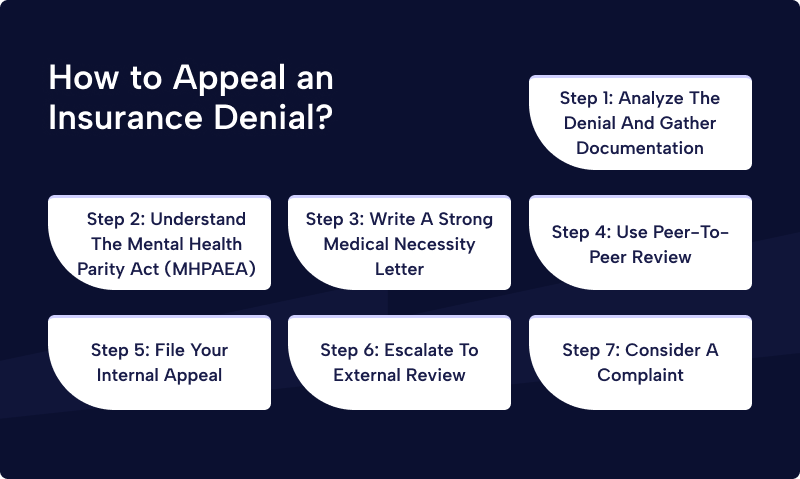
Step 1: Analyze the Denial and Gather Documentation
Before any action, you need to understand the payer’s specific reason for denial. This information is found on the Explanation of Benefits (EOB) or denial letter. The denial reason determines your appeal strategy. Common reasons for mental health claim denials include:
- Medical Necessity: The insurer has determined the treatment is not medically necessary. This is the most frequent reason for clinical denials. Insurers use proprietary criteria to make these decisions, which are often not made public.
- Prior Authorization: The required authorization was not obtained before the service was rendered. This is an administrative failure.
- Out-of-Network: The provider is not in the patient’s network. Telehealth coverage may also be restricted to in-network providers.
- Administrative Errors: This includes incorrect CPT or ICD-10 codes, late claim submission, or incomplete claim forms.
Gather Comprehensive Supporting Documents
A successful appeal hinges on providing clear, evidence-based documentation. At a minimum, you should have ready:
- The denial letter (EOB) and any associated correspondence
- A copy of the patient’s insurance policy highlighting the mental health benefits section
- The patient’s medical records, including progress notes, diagnosis, and treatment plan
- A strong Medical Necessity Letter from the treating provider
- Any relevant clinical guidelines or peer-reviewed literature supporting the treatment
Step 2: Understand the Mental Health Parity Act (MHPAEA)
The Mental Health Parity and Addiction Equity Act (MHPAEA) is a federal law that requires insurance plans offering mental health and substance use disorder benefits to provide coverage at levels no more restrictive than medical/surgical benefits. The 2024 final rule strengthened enforcement significantly. Plans must now conduct and document comparative analyses of their NQTLs, demonstrating that factors and evidentiary standards used for MH/SUD benefits are comparable to those for medical/surgical benefits.
Common parity violations include:
- More burdensome prior authorization requirements for residential treatment than for comparable medical admissions
- Narrower provider networks for MH/SUD services
- More restrictive formulary placement for psychiatric medications
- Higher denial rates for behavioral health claims
These violations often persist because they involve Non-Quantitative Treatment Limitations (NQTLs) that are harder to identify and challenge than explicit day caps or copay differences.
What a Parity-Violation Denial Looks Like
Recognizing a parity violation is the first step to a successful appeal. The most common patterns in behavioral health denial queues include:
- Exceeded medical necessity criteria. The payer requires six-month re-authorization for ongoing psychotherapy but does not require the same for physical therapy of equivalent intensity. That is an NQTL applied more restrictively to BH benefits.
- Service exceeds frequency guidelines. The plan caps psychotherapy at 20 sessions per year but does not cap cardiology follow-ups. That is a quantitative treatment limit applied disparately.
- Provider type not covered for this CPT code. Master’s-level clinicians (LMFT, LCSW, LPC) are denied for codes that would pay if billed by an MD. If the same code billed by a similar-credentialed practitioner in med-surg would pay, it is a parity issue.
| What Payers Do When They Receive a Properly Framed Parity Appeal Data from experienced revenue cycle management shops shows that approximately 40% of properly framed parity appeals pay on first-level appeal when the appeal includes proper MHPAEA citation, an equivalent med-surg comparison, and a request for comparative analysis. About 25% deny first-level but pay on second-level. About 15% pay during external review. The total recovery rate on properly worked parity appeals is 75-85%. |
Step 3: Write a Strong Medical Necessity Letter
The medical necessity letter is often the most critical element of a successful appeal, especially when the denial is based on clinical grounds. A template from the mental health advocacy resource, Cover My Mental Health, and the American Psychiatric Association provides an excellent foundation for this letter.
Key Elements of an Effective Appeal Letter
1. Introduction. State clearly who you are, your relationship with the patient, the patient’s diagnosis, and a direct statement that you are appealing the denial. Include the patient’s date of birth and health plan ID.
2. Provider Credentials. Describe your qualifications and level of experience in treating patients with this specific diagnosis. This establishes your credibility and expertise.
3. Clinical History. Provide a detailed chronology of the patient’s mental health history, including prior treatments tried, medications, and any past hospitalizations. Describe the patient’s level of functioning and specific symptoms.
4. Rationale for Treatment. Explain why the requested treatment is medically necessary. Justify the level of care, frequency, and duration based on evidence-based standards. Cite clinical guidelines from organizations like APA, AACAP, or ASAM to support your argument.
5. Address the Denial and Plan Criteria. Go through the plan’s criteria and explain how the patient meets them. If the patient does not meet plan criteria, use community standards such as LOCUS, CASII, or ASAM criteria to demonstrate medical necessity. Different criteria exist for admission and continued stay, and for children/adolescents versus adults.
6. Procedural Violations. If there have been any, cite the state or federal code that the plan violated. Examples include failing to timely respond to claims, failing to provide access to an adequate network, or failing to provide the client with a plan manual.
7. Conclusion. Briefly summarize your argument and reiterate the request for coverage.
| A Real-World Example: A child and adolescent psychiatrist in Chicago treated a teenage girl with obsessive-compulsive disorder whose symptoms became severe. The insurance company initially denied daily therapy, allowing only once a week. Doctor gathered evidence about the efficacy of exposure therapy, wrote a letter to the insurance company, and was able to get the company to approve therapy three times a week. “This girl got better within six weeks, was able to go back to school, and eventually tapered the therapy to once a week,” Doctor said. |
Free Resources for Medical Necessity Letters
Cover My Mental Health is a nonprofit organization that provides free tools for challenging insurance denials, including a template for writing medical necessity letters. The site offers practical information and sample text for how to write an effective letter of medical necessity.
The Austen Riggs Center provides two sets of resources to support clinician and patient efforts to secure insurance coverage for medically necessary behavioral health treatment.
Step 4: Use Peer-to-Peer Review
For many clinical denials, a peer-to-peer review can be incredibly effective. This is a call or review between the patient’s treating clinician and an insurance company physician. This direct conversation can clarify clinical nuance that may be lost in a written document.
Practical Advice. The insurance reviewer on a case may not be a specialist in child psychiatry or the specific condition being treated. The treating clinician can explain special considerations involved in treating a specific population or condition. This often leads to approval or a compromise.
Step 5: File Your Internal Appeal
Follow the Payer’s Process and Deadlines
The provider or patient should first follow the insurance company’s internal appeals process. Deadlines are strict, typically requiring an appeal within 30 to 180 days of the denial notice. Most plans give you about 180 days from the date of the denial notice to appeal internally, but experts say not to wait.
- What to Include. Make sure to send the appeal to the correct department (e.g., “Medical Director” or “Appeals Department”). Use the payer’s preferred submission method, such as mail, fax, or a provider portal. Keep copies of everything you send and note the date.
- State Consumer Assistance Programs. Not all states have consumer assistance programs, but those that do offer free services to help patients understand and appeal denials. They can use their time, experience, and resources to explain the process and even write appeals.
Understanding Success Rates
The Virginia Bureau of Insurance reported that health carriers upheld denied claims involving mental health benefits in 64% of closed internal appeals. However, this means 36% were overturned on appeal. Persistence pays off.
Step 6: Escalate to External Review
If the internal appeal is unsuccessful, you have the right to request an external review. This is an independent review of the case by a third-party organization not affiliated with the insurance company. The outcome of an external review is often binding on the insurer.
A Real-World Example. A North Carolina couple’s insurance denied coverage for intensive psychiatric care, even after the husband attempted suicide twice. The instructions for an external review were buried on page seven of one denial letter. After submitting the request, an independent doctor overturned the denial, forcing the insurer to cover treatment that had cost the family more than $70,000.
Filing for External Review
When you file a request for a federal external review, your plan usually has five days to consider your request. If the insurer agrees that your denial is eligible, it will provide directions on where to file the appeal. Under federal rules, third-party review companies typically have between 45 and 60 days to decide the outcome of an external review.
Expedited External Appeals. If the situation is urgent, you may ask for an expedited appeal. Federal requirements typically call for expedited external appeals to occur as quickly as your condition requires but not take longer than 72 hours.
Success Rates of External Reviews
A study of independent medical review (IMR) appeals in California found that 50% of initially denied claims for depression treatment were overturned. This suggests that managed care organizations inappropriately deny claims and delay treatment. The study also found that reviews mentioning the CALOCUS (Child and Adolescent Level of Care Utilization System) criteria were more likely to be overturned (OR=1.5). Using standardized tools like CALOCUS, LOCUS, or ASAM can significantly improve appeal outcomes.
Connecticut data shows that the health care advocate office has been able to resolve or overturn denials in the patient’s favor about 80% of the time.
Step 7: Consider a Complaint
Patients have the option to file a complaint with their state’s Office of the Insurance Commissioner, which can investigate the issue, require the insurer to correct any unlawful actions, and impose penalties when appropriate.
Texas. The Texas Department of Insurance offers a Help Line that can answer insurance questions and explain appeal options. External reviews are free to the patient.
Additional Strategies to Maximize Success
Use Standardized Criteria Tools
Standardized criteria tools like the Level of Care Utilization System (LOCUS), Child and Adolescent Level of Care Utilization System (CALOCUS), and American Society of Addiction Medicine (ASAM) criteria are effective in appeals.
A study found that CALOCUS mention was independently associated with appeal overturns in California. These tools provide a systematic, evidence-based framework for determining the appropriate level of care.
Request the Payer’s Medical Necessity Criteria
When the denial is based on medical necessity, request a copy of the medical necessity criteria and specific reasons for denial the insurer is using. These criteria are often proprietary but must be provided upon request. Once you have them, you can compare them to established community standards and show how the patient meets them.
Cite Clinical Guidelines
Cite evidence-based clinical guidelines from professional organizations in the appeal letter. The Cover My Mental Health website emphasizes that a medical necessity letter can draw on evidence-based guidelines developed by APA, AACAP, ASAM, and other professional societies. These guidelines carry significant weight because they represent generally accepted standards of care.
Get State Regulatory Help
- Maryland. Insurers must include information at the top of all denial letters in “prominent bold print” that states the member has the right to appeal or file a complaint. The Health Education and Advocacy Unit’s address and phone number must also be included.
- Connecticut. Denial letters must include a box on the front page with appeal information.
- New York. The Community Service Society helps New York residents write appeals, sometimes going through thousands of pages of medical records and writing 15- to 20-page appeals.
Maintain a Records Retention Policy
Keep all denial letters, explanation of benefits, correspondence, and plan documents. Most people have a right to request their claim file under federal regulations. If you have misplaced anything, contact the insurer for additional copies.
The First Letter Is the Hardest
Writing a medical necessity letter takes time and is not billable time. Dr. Karen Pierce acknowledges this: “Physicians are busy; it takes time to write a letter, it’s not billable time, and people see it as extra work. The first letter is the most difficult to write, but once you learn how to do it and have the template, you can write it and revise it quickly as many times as needed”.
The Bottom
Appealing a mental health insurance denial is a systematic process.
Success depends on careful analysis, robust documentation, and a clear understanding of both the payer’s policies and the patient’s rights under parity laws.
The financial return is significant, with 75-85% recovery rates on properly worked parity appeals.
While it is a significant administrative burden, persistence pays off. By following these steps, providers can effectively fight for the coverage their patients are legally owed.