
CPT 90791 and 90837 both play an important role in mental health billing, but they represent two very different services. CPT 90791 covers a psychiatric diagnostic evaluation, while CPT 90837 covers a 60-minute psychotherapy session. Understanding the difference helps mental health providers choose the right code, support medical necessity, document services accurately, and avoid claim denials. This guide differentiates CPT 90791 vs 90837, when to use each code, key documentation requirements, billing rules, reimbursement factors, and common mistakes.
CPT 90791 vs 90837: What Is the Difference?
Mental health providers often use CPT Code 90791 and CPT Code 90837 during outpatient behavioral health services, but these codes describe very different types of services.
- CPT 90791 represents a psychiatric diagnostic evaluation without medical services.
- CPT 90837 represents psychotherapy, 60 minutes with the patient.
The biggest difference comes down to the purpose of the service.
- A provider uses 90791 when conducting a comprehensive psychiatric diagnostic evaluation. The provider gathers information, evaluates the patient’s condition, develops a diagnostic impression, and creates a treatment plan.
- A provider uses 90837 for an ongoing psychotherapy session that meets the applicable time requirement.
This distinction matters because practices cannot choose between these codes simply by looking at the length of the appointment. The provider must report the code that accurately represents the service performed and documented.
For mental health practices, accurate code selection affects claim acceptance, reimbursement, compliance, and the patient’s financial responsibility.
CPT 90791 vs 90837 at a Glance
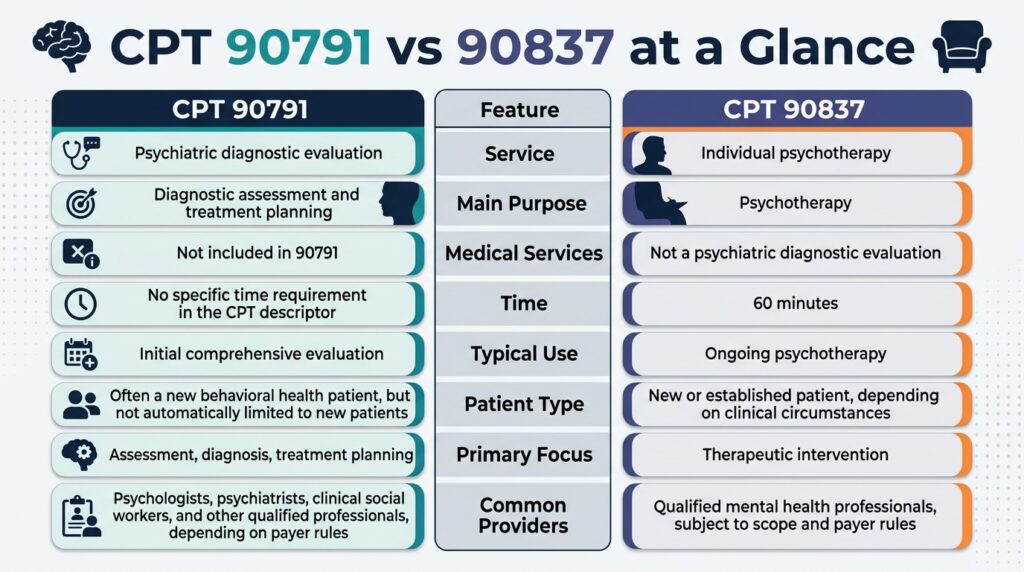
The exact professionals who may report these codes depend on state law, payer policy, credentialing, and scope of practice.
What Is CPT Code 90791?
CPT 90791 describes a psychiatric diagnostic evaluation without medical services.
The provider performs a comprehensive evaluation to understand the patient’s behavioral health needs.
During the evaluation, the provider may gather information about:
- The patient’s presenting concerns.
- Current symptoms.
- Psychiatric history.
- Relevant medical history.
- Family and social history.
- Substance use history when clinically relevant.
- Mental status.
- Psychosocial factors.
- Risk factors.
- Functional impairment.
- Previous treatment.
- Current medications when relevant.
- Diagnostic considerations.
- Treatment needs.
The provider then uses the information gathered during the evaluation to develop a diagnostic impression and treatment plan.
The service may involve clinical interviewing, assessment, and treatment planning. However, providers should follow the current CPT guidelines and payer requirements when determining whether the service supports 90791.
What Is CPT Code 90837?
CPT 90837 represents psychotherapy, 60 minutes with the patient.
The provider uses this code when delivering individual psychotherapy that meets the applicable CPT time requirements.
The session may address issues such as:
- Anxiety.
- Depression.
- Trauma related symptoms.
- Stress.
- Relationship concerns.
- Behavioral issues.
- Coping skills.
- Emotional regulation.
- Grief.
- Other mental health conditions.
The provider should document the therapeutic work performed during the session and explain how the intervention relates to the patient’s treatment goals and clinical needs.
A note that simply says “patient doing well” generally does not provide enough information to demonstrate the psychotherapy service.
The medical record should show what the provider addressed and how the provider provided psychotherapy.
CPT 90791 vs 90837: The Main Difference
The easiest way to understand the distinction is to look at the encounter’s purpose.
CPT 90791 focuses on evaluation.
The provider evaluates the patient’s mental health condition, gathers relevant information, develops a diagnostic impression, and, when appropriate, establishes or updates a treatment plan.
CPT 90837 focuses on psychotherapy.
The provider conducts an individual psychotherapy session that meets the applicable time requirement.
Think of it this way:
- 90791 answers: “What is happening with this patient, and what treatment does the patient need?”
- 90837 answers: “How did the provider provide psychotherapy to address the patient’s identified treatment needs?”
This distinction helps providers and coders select the appropriate code.
Does CPT 90791 Have a Time Requirement?
CPT 90791 does not carry a specific time range in the same way that psychotherapy codes such as 90834 and 90837 do.
The provider should report 90791 when the service meets the CPT definition and the documentation supports the comprehensive diagnostic evaluation.
The provider should not select 90791 solely because the appointment lasted a certain number of minutes.
Instead, the medical record should demonstrate the work involved in the psychiatric diagnostic evaluation.
The provider should also document enough clinical information to support the diagnosis and treatment plan.
How Long Is CPT 90837?
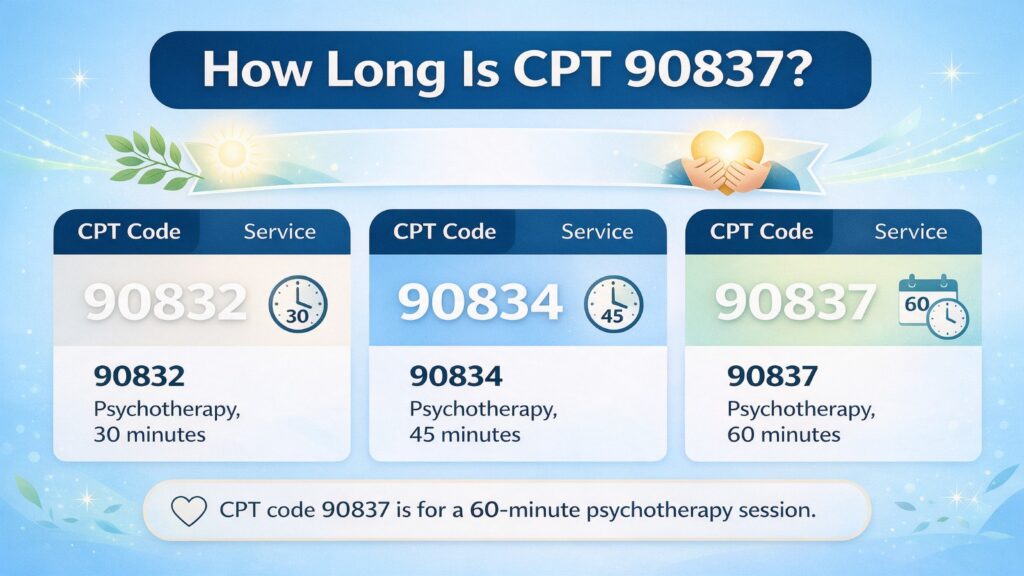
CPT 90837 represents 60 minutes of psychotherapy with the patient.
The psychotherapy code family includes time-based codes such as:
Providers should follow the current CPT psychotherapy time guidance when selecting the appropriate code.
Do not assume that every session lasting close to an hour automatically supports 90837.
The documentation should support the reported service and the payer’s requirements.
CPT 90791 vs 90837: Can You Bill Both?
In many cases, providers should not report 90791 and 90837 for the same encounter.
The codes describe different services.
90791 represents the psychiatric diagnostic evaluation.
90837 represents individual psychotherapy.
If the provider performs a diagnostic evaluation and then provides psychotherapy during the same encounter, the provider must carefully review the CPT guidelines and payer policy before reporting both services.
Some payers may restrict separate reporting, while others may apply specific policies.
The provider should never report both codes simply to increase reimbursement.
The documentation must support each separately reported service, and the payer must allow the combination.
Can You Bill CPT 90791 More Than Once?
The answer depends on the clinical situation and payer policy.
A provider may perform another diagnostic evaluation when the patient’s clinical circumstances justify a new comprehensive evaluation.
However, providers should not automatically report 90791 at every appointment.
For example, a patient who returns for routine psychotherapy usually does not require another psychiatric diagnostic evaluation at every visit.
If the patient’s condition changes significantly or the provider needs to conduct another comprehensive diagnostic assessment, the provider should document the reason clearly.
Payer policies may also restrict how frequently the code can receive reimbursement.
Always check the patient’s specific payer policy.
CPT 90791 vs 90837 Documentation Requirements
Strong documentation supports accurate coding and helps protect the practice during audits.
CPT 90791 Documentation
A 90791 record should support the psychiatric diagnostic evaluation.
Depending on the clinical circumstances, documentation may include:
- Reason for the evaluation.
- Presenting problems.
- Relevant psychiatric history.
- Medical history when clinically relevant.
- Social and family history.
- Substance use history when appropriate.
- Mental status findings.
- Risk assessment when clinically indicated.
- Relevant psychosocial factors.
- Diagnostic impression.
- Diagnosis or diagnoses.
- Clinical formulation.
- Treatment recommendations.
- Initial treatment plan.
The provider should document information that supports the clinical assessment rather than copying a generic template into every note.
CPT 90837 Documentation
A 90837 record should support the psychotherapy service.
Documentation should generally establish:
- The reason for the session.
- The condition or problems addressed.
- The therapeutic interventions used.
- The patient’s response or progress.
- The connection between treatment and the patient’s clinical needs.
- The treatment plan or goals when relevant.
- The duration or time information required to support the reported psychotherapy code.
The provider should focus on the actual clinical work performed.
For example, instead of writing:
“Patient discussed anxiety.”
A stronger note might explain:
“The patient reported increased anxiety related to workplace stress. The provider used cognitive behavioral techniques to identify recurring negative thought patterns and practiced cognitive restructuring. The patient identified two triggers and developed a plan to use breathing exercises and thought challenging techniques during stressful situations.”
The second example gives a clearer picture of the clinical work.
CPT 90791 vs 90837 Medical Necessity
Medical necessity plays a central role in behavioral health billing.
A claim may face denial even when the provider selected the correct CPT code if the documentation does not establish why the service was medically necessary.
For 90791, the record should explain why the patient required a psychiatric diagnostic evaluation.
For 90837, the record should explain why the patient required psychotherapy and how the provider addressed the patient’s clinical needs.
The diagnosis alone does not automatically prove medical necessity.
The medical record should connect the patient’s condition with the service provided.
CPT 90791 vs 90837 Modifiers
Modifier requirements depend on the circumstances and payer policy.
Providers should not add modifiers automatically.
Common modifier considerations may include:
Modifier 25
Modifier 25 generally applies when the provider performs a significant, separately identifiable E/M service on the same day as another procedure or service.
It does not apply simply because the provider reports 90791 or 90837.
Modifier 59
Modifier 59 generally identifies a distinct procedural service when the applicable circumstances support its use.
Providers should not use modifier 59 as a routine way to bypass payer edits.
Telehealth Modifiers
Some payers may require specific telehealth modifiers or place of service codes.
Medicare and commercial payers may follow different rules.
Mental health practices should verify current payer requirements before submitting telehealth claims.
CPT 90791 vs 90837 Reimbursement
Reimbursement varies significantly by payer.
Factors that can affect payment include:
- Insurance plan.
- Provider specialty.
- Provider credential.
- Geographic location.
- Network participation.
- Contracted rate.
- Place of service.
- Telehealth policy.
- Payer medical necessity rules.
- Authorization requirements.
- Claim submission accuracy.
Practices should not rely on a single national reimbursement figure.
Instead, billing teams should verify contracted rates and payer fee schedules.
A behavioral health practice should also monitor actual payments against expected reimbursement.
For example, if a payer consistently reimburses 90837 below the contracted rate, the practice should investigate the EOB or ERA and determine whether the payer processed the claim correctly.
CPT 90791 vs 90837 Common Billing Mistakes
Mistake 1: Using 90837 for Every Therapy Session
Not every psychotherapy appointment meets the requirements for 90837.
How to avoid it
Select the psychotherapy code that accurately reflects the service and applicable time requirements.
Mistake 2: Billing 90791 for Routine Therapy
A diagnostic evaluation and psychotherapy session serve different purposes.
How to avoid it
Use 90791 for qualifying psychiatric diagnostic evaluations and psychotherapy codes for qualifying therapy sessions.
Mistake 3: Choosing the Code Based Only on Appointment Length
Time alone does not automatically determine every behavioral health code.
How to avoid it
Review the actual service performed, applicable CPT guidelines, documentation, and payer policy.
Mistake 4: Using Generic Psychotherapy Notes
A vague note may not support medical necessity.
How to avoid it
Document the patient’s clinical needs, interventions, response, and treatment progress.
Mistake 5: Ignoring Authorization Requirements
Some insurance plans require authorization for behavioral health services.
How to avoid it
Verify benefits and authorization requirements before providing services whenever possible.
Mistake 6: Billing the Wrong Provider Type
Payers may restrict certain services based on provider credentials or enrollment.
How to avoid it
Verify the provider’s credentialing and payer participation before submitting claims.
Mistake 7: Ignoring Payer Specific Policies
A payer may apply its own coverage and documentation requirements.
How to avoid it
Check the patient’s plan and payer policy before billing.
Final Thoughts
CPT 90791 and CPT 90837 both play important roles in behavioral health billing, but they describe different services.
90791 focuses on psychiatric diagnostic evaluation.
90837 focuses on individual psychotherapy.
The safest approach involves coding from the actual service provided rather than choosing a code based on appointment length, reimbursement expectations, or habit.
Mental health practices should also keep medical necessity, documentation, payer policies, authorization requirements, provider credentials, and telehealth rules in mind.
Accurate behavioral health billing requires attention to detail at every stage, from eligibility verification to claim submission and payment posting. A strong revenue cycle process helps providers receive appropriate reimbursement while maintaining accurate billing practices.
Need Help Managing Your Mental Health Billing?
Behavioral health billing can become complicated quickly. Payer rules change, authorization requirements vary, and even small documentation or coding issues can delay payment.
Mental Health Billing helps healthcare practices manage the billing process so providers can spend less time chasing claims and more time focusing on patient care.
From claim submission and denial management to payment posting and accounts receivable follow-up, the right billing support can help your practice keep its revenue cycle moving.
Stop letting billing issues take time away from patient care.
Connect with Mental Health Billing today
Frequently Asked Questions
What is the main difference between CPT 90791 and 90837?
CPT 90791 represents a psychiatric diagnostic evaluation without medical services. CPT 90837 represents individual psychotherapy, 60 minutes with the patient.
Can a psychologist bill CPT 90791?
A psychologist may report 90791 when the service falls within the psychologist’s scope of practice and the payer allows reimbursement for the service.
Can a therapist bill CPT 90837?
Qualified mental health professionals may report 90837 when they meet applicable scope of practice, credentialing, and payer requirements.
Is CPT 90837 always a 60-minute session?
CPT 90837 represents 60 minutes of psychotherapy. Providers should follow current CPT time guidance when determining whether the service supports the code.
Can I bill 90791 at every first visit?
No. The provider should use 90791 when the encounter meets the requirements for a psychiatric diagnostic evaluation. A routine psychotherapy session does not automatically qualify.
Can I use CPT 90837 for telehealth?
Telehealth coverage depends on the payer and applicable regulations. Verify current payer requirements for coverage, place of service, modifiers, and provider eligibility.
Does CPT 90837 require prior authorization?
Some insurance plans require authorization for psychotherapy services, while others do not. Always verify the patient’s benefits and payer requirements.