
Running a successful therapy practice requires much more than delivering excellent patient care. Every session you provide also needs accurate coding, proper documentation, and timely reimbursement.
Unfortunately, many psychologists, psychiatrists, licensed professional counselors, marriage and family therapists, licensed clinical social workers, and behavioral health practices struggle with inconsistent insurance payments. One payer reimburses generously while another pays much less for the same CPT code. That often leaves providers wondering whether their reimbursement rates are fair.
This guide explains how psychotherapy reimbursement works in the United States, what affects payment amounts, how Medicare and commercial insurance compare, and what you can do to increase collections without increasing patient volume.
Whether you own a solo private practice or manage a large behavioral health organization, you’ll find practical information that helps you improve revenue while remaining fully compliant.
What Are Insurance Reimbursement Rates for Psychotherapy?
Insurance reimbursement rates refer to the amount an insurance company pays a provider for delivering psychotherapy services.
The payment depends on several factors instead of a single national price.
These include:
- CPT code billed
- Provider credentials
- Geographic location
- Insurance company
- Contracted reimbursement agreement
- Place of service
- Medical necessity
- Documentation quality
- Patient benefits
For example, two therapists may provide the exact same 45-minute psychotherapy session using CPT 90834. One practice may receive $95 while another receives $145 because each practice negotiated different contracts with the insurance company.
This explains why reimbursement varies widely across the United States.
CMS updates Medicare payment policies every year through the Medicare Physician Fee Schedule. Many commercial insurers use Medicare as a benchmark when developing their own payment schedules, although each insurer establishes its own contracted rates.
Why Understanding Reimbursement Matters
Strong reimbursement directly affects the financial health of your practice.
Higher reimbursement helps you:
- Increase profitability
- Hire additional clinicians
- Invest in technology
- Reduce financial stress
- Expand patient access
- Maintain quality care
Even a $15 increase per psychotherapy visit can translate into tens of thousands of additional annual revenue for busy practices.
Example
A therapist who completes:
- 28 visits each week
- 48 working weeks each year
Performs approximately 1,344 sessions annually.
If reimbursement increases by only $15 per visit:
1,344 × $15 = $20,160 additional annual revenue.
Small improvements create meaningful financial results.
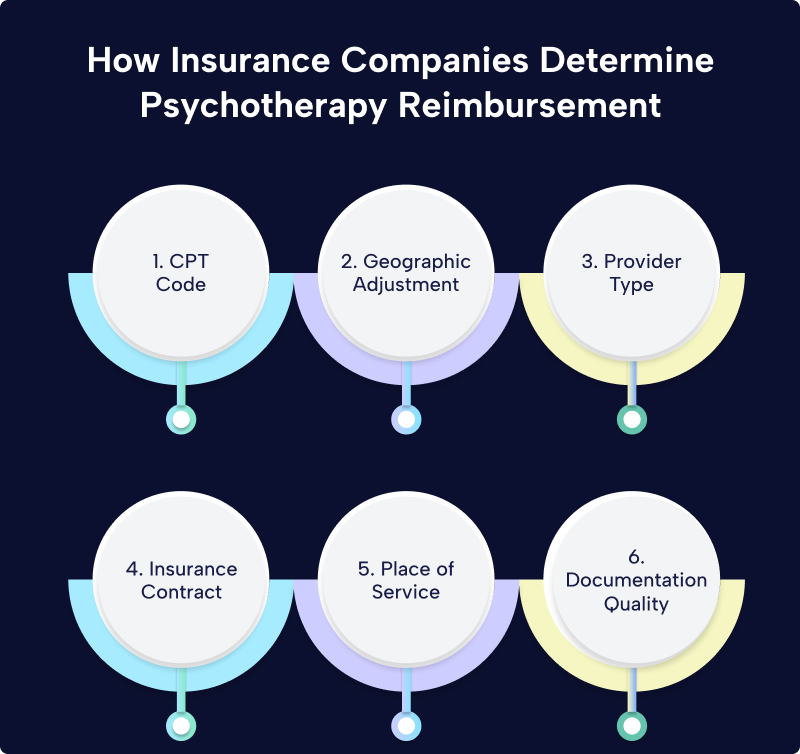
How Insurance Companies Determine Psychotherapy Reimbursement
Many providers assume insurers randomly assign payment amounts.
That is not how reimbursement works.
Insurance companies evaluate multiple factors before determining payment.
1. CPT Code
Every psychotherapy service uses a CPT code.
Longer, more complex services generally receive higher reimbursement.
2. Geographic Adjustment
Practices in New York City usually receive different Medicare payments than practices in rural Kansas.
CMS adjusts payments using Geographic Practice Cost Indices (GPCIs) to reflect regional cost differences.
3. Provider Type
Payment may differ for:
- Clinical Psychologists
- Psychiatrists
- Nurse Practitioners
- Licensed Clinical Social Workers
- Licensed Professional Counselors
- Marriage and Family Therapists
For Medicare, Marriage and Family Therapists (MFTs) and Mental Health Counselors (MHCs) receive 75 percent of the psychologist payment rate for covered services.
4. Insurance Contract
Commercial contracts vary significantly.
One insurer may reimburse:
- 120% of Medicare
- 150% of Medicare
- 180% of Medicare
Others negotiate fixed dollar amounts instead. Industry benchmarking commonly places commercial behavioral health reimbursement between roughly 120% and 200% of Medicare, although actual contracts vary by payer and market.
5. Place of Service
Payment may differ depending on where care occurs.
Examples include:
- Office
- Hospital outpatient department
- Community clinic
- Telehealth
- Skilled nursing facility
6. Documentation Quality
Excellent documentation protects reimbursement.
Incomplete records often lead to:
- Claim denials
- Medical record requests
- Audits
- Recoupments
- Delayed payment
Understanding Medicare Reimbursement
Medicare remains one of the most transparent payment systems in healthcare.
CMS publishes payment values each year using the Medicare Physician Fee Schedule.
Although Medicare payments may appear lower than some commercial plans, they provide an important benchmark across behavioral health.
Providers should remember that actual Medicare reimbursement differs by locality because of geographic adjustments and other payment factors.
Medicare Psychotherapy CPT Codes and Reimbursement Rates
One of the biggest mistakes providers make is choosing a CPT code based only on session length. Each psychotherapy CPT code has specific documentation and billing requirements. Using the wrong code can reduce reimbursement or trigger claim denials.
Below are the most commonly billed psychotherapy CPT codes.
Important: Medicare payment varies by geographic location, provider type, and annual fee schedule updates. Commercial insurance plans establish their own contracted reimbursement amounts, which often differ substantially from Medicare.
| CPT Code | Description | Medicare Reimbursement Rates 2025 | Medicare Reimbursement Rates 2026 |
| 90791 | Psychological Diagnostic Evaluation | $166.91 | $173.35 |
| 90792 | Psychological Diagnostic Evaluation with Medication Management | $187.93 | $202.08 |
| 90832 | Individual Psychotherapy, 30 Minutes | $78.93 | $85.84 |
| 90833 | Individual Psychotherapy with Evaluation and Management Services, 30 minutes | $72.78 | $81.50 |
| 90834 | Individual Psychotherapy, 45 Minutes | $104.16 | $113.90 |
| 90836 | Individual Psychotherapy with Evaluation and Management Services, 45 minutes | $92.51 | $103.21 |
| 90837 | Individual Psychotherapy, 60 Minutes | $154.29 | $167.00 |
| 90838 | Individual Psychotherapy with Evaluation and Management Services, 60 minutes | $122.92 | $136.61 |
| 90839 | Individual Crisis Psychotherapy initial 60 min | $148.47 | $160.32 |
| 90840 | Individual Crisis Psychotherapy initial 60 min, each additional 30 min | $72.78 | $77.16 |
| 90845 | Psychoanalysis | $99.30 | $109.22 |
| 90846 | Family psychotherapy (without the patient present), 50 minutes | $98.66 | $105.88 |
| 90847 | Family psychotherapy (conjoint psychotherapy) (with patient present), 50 minutes | $102.86 | $109.55 |
| 90849 | Multiple-family group psychotherapy | $37.52 | $40.42 |
| 90853 | Group psychotherapy (other than of a multiple-family group) | $28.14 | $30.39 |
| 99202 | Evaluation and Management Services, Outpatient, New Patient | $69.87 | $75.15 |
| 99203 | Evaluation and Management Services, Outpatient, New Patient | $109.01 | $117.57 |
| 99204 | Evaluation and Management Services, Outpatient, New Patient | $163.35 | $177.36 |
| 99205 | Evaluation and Management Services, Outpatient, New Patient | $215.75 | $236.81 |
| 99211 | Evaluation and Management Services, Outpatient, Established Patient | $22.64 | $24.38 |
| 99212 | Evaluation and Management Services, Outpatient, Established Patient | $54.99 | $59.45 |
| 99213 | Evaluation and Management Services, Outpatient, Established Patient | $88.95 | $95.19 |
| 99214 | Evaluation and Management Services, Outpatient, Established Patient | $125.18 | $135.61 |
| 99215 | Evaluation and Management Services, Outpatient, Established Patient | $175.64 | $192.39 |
| 96105 | Assessment of aphasia and cognitive performance | $93.80 | $97.20 |
| 96112 | Developmental testing administration by a physician or qualified health care professional, 1st hr | $127.12 | $125.25 |
| 96113 | Developmental testing administration by a physician or qualified health care professional, each additional hour | $53.37 | $56.11 |
| 96116 | Neurobehavioral status exam performed by a physician or qualified health professional, first hour | $88.63 | $94.19 |
| 96121 | Neurobehavioral status exam performed by a physician or qualified health professional, additional hour | $72.78 | $75.49 |
| 96125 | Standardized cognitive performance test administered by health care professional | $99.63 | $102.87 |
| 96127 | Brief emotional and behavioral assessment | $4.53 | $5.01 |
| 96130 | Psychological testing and evaluation by a physician or qualified health care professional, first hour | $117.42 | $123.92 |
| 96131 | Psychological testing and evaluation by a physician or qualified health care professional, each additional hour | $82.81 | $86.51 |
| 96132 | Neuropsychological testing and evaluation by a physician or qualified health care professional, first hour | $125.18 | $122.25 |
| 96133 | Neuropsychological testing and evaluation by a physician or qualified healthcare professional, each additional hour | $93.48 | $97.86 |
| 96136 | Neuropsychological or psychological test administration and scoring by a physician or qualified health care professional, first hour | $40.76 | $43.76 |
| 96137 | Neuropsychological or psychological test administration and scoring by a physician or qualified health care professional, each additional hour | $35.90 | $37.07 |
| 96138 | Neuropsychological or psychological test administration and scoring by a technician, first hour | $33.64 | $37.74 |
| 96139 | Neuropsychological or psychological test administration and scoring by a technician, each additional hour | $33.64 | $35.40 |
(Source)
These figures serve only as general benchmarks. Your contracted reimbursement may differ based on negotiations, payer policies, and regional market conditions.
Medicare Reimbursement Increased in 2026
Many behavioral health CPT codes received higher national Medicare reimbursement in 2026.
Examples include:
| CPT | Increase |
| 90791 | +$6.44 |
| 90792 | +$14.15 |
| 90832 | +$6.91 |
| 90834 | +$9.74 |
| 90837 | +$12.71 |
| 90839 | +$11.85 |
| 90846 | +$7.22 |
| 90847 | +$6.69 |
Medicare 90791 Reimbursement by State (2026)
| State | Average |
| Alaska | $240.07 |
| California (Santa Clara) | $203.39 |
| California (San Mateo) | $206.69 |
| Washington (Seattle) | $189.73 |
| New Jersey (North) | $188.58 |
| Washington DC | $188.26 |
| Texas (Dallas) | $174.32 |
| Florida (Miami) | $174.47 |
| Illinois (Chicago) | $170.47 |
| Ohio | $169.49 |
Average Commercial Insurance Reimbursement by Payer
| Insurance Company | Typical Range |
| Aetna | $78 to $98 |
| Anthem BCBS | $74 to $96 |
| Blue Cross Blue Shield | $72 to $102 |
| Cigna | $71 to $92 |
| UnitedHealthcare | $73 to $86 |
| Carelon | $72 to $86 |
| Molina | $68 to $78 |
| MHN | $67 to $75 |
These are estimated contracted ranges reported by providers and vary by state, specialty, and negotiated agreement.
How Provider Credentials Affect Reimbursement
| License | CPT 90834 | CPT 90837 |
| LPC | $72 | $81 |
| LMFT | $79 | $92 |
| LICSW | $73 | $79 |
| Psychiatrist (MD) / PhD | $90 | $109 |
Sample Medicaid Psychotherapy Reimbursement
CPT 90834
| Practitioner Level | Rate |
| Level 2 | $76.87 |
| Level 3 | $57.29 |
| Level 4 | $39.01 |
| Level 5 | $31.88 |
CPT 90837
| Practitioner Level | Rate |
| Level 2 | $121.40 |
| Level 3 | $95.65 |
| Level 4 | $82.41 |
| Level 5 | $48.22 |
Which Insurance Companies Usually Pay Higher Rates?
Many providers ask the same question.
Which insurance company reimburses the most?
There is no single answer because reimbursement varies by state and contract. However, providers often report stronger reimbursement from certain commercial payers in competitive markets.
Examples include:
- Blue Cross Blue Shield plans
- Aetna
- Cigna Healthcare
- UnitedHealthcare
- Kaiser Permanente (in participating regions)
- Humana
- Optum Behavioral Health
Keep in mind that a higher reimbursement rate does not always produce greater profit.
For example:
- One payer may reimburse $165 per session but take 45 days to pay.
- Another may reimburse $150 but consistently pay within 10 business days.
The second payer may provide healthier cash flow despite the slightly lower reimbursement.
Practice owners should evaluate the complete picture, including:
- Payment speed
- Denial rate
- Authorization requirements
- Administrative workload
- Appeal success rate
- Patient volume
- Contract terms
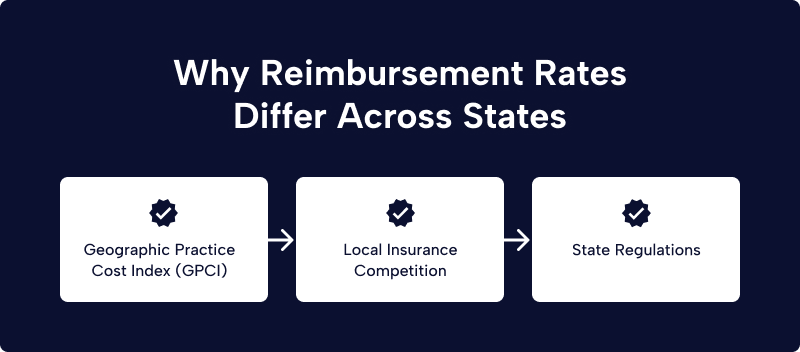
Why Reimbursement Rates Differ Across States
Many providers compare reimbursement with colleagues in other states and wonder why the numbers differ.
Several factors influence payment by location.
Geographic Practice Cost Index (GPCI)
Medicare adjusts reimbursement using the Geographic Practice Cost Index.
The formula reflects local costs such as:
- Office rent
- Employee wages
- Professional liability insurance
- Operating expenses
Practices in cities with higher operating costs generally receive higher Medicare reimbursement than practices in lower cost areas.
Local Insurance Competition
Commercial insurers also evaluate market conditions.
Areas with a shortage of behavioral health providers often see stronger reimbursement because insurers need larger provider networks.
Markets with many competing providers may experience lower negotiated rates.
State Regulations
Some states enforce stronger mental health parity protections or maintain different Medicaid reimbursement policies.
These regulations can affect overall reimbursement for behavioral health services.
Private Practice Versus Group Practice Reimbursement
Many therapists believe joining a large practice automatically increases reimbursement.
That is not always true.
Solo Private Practice
Advantages include:
- Full control over contracts
- Flexible scheduling
- Lower administrative complexity
- Direct relationship with patients
Challenges include:
- Limited negotiating power
- Smaller payer network
- Greater administrative workload
Group Practice
Advantages include:
- Better contract negotiations
- Larger patient volume
- Shared administrative staff
- Centralized billing
- Greater leverage during payer discussions
Challenges include:
- Revenue sharing
- Management costs
- Operational overhead
Large behavioral health organizations sometimes negotiate reimbursement rates above those available to solo providers because they deliver higher patient volume and broader network coverage. Even so, individual contract terms vary significantly by payer and market.
Does Telehealth Pay the Same as In-Person Therapy?
Telehealth reimbursement has changed considerably over the last several years.
During the COVID-19 public health emergency, many insurers reimbursed virtual therapy at the same rate as office visits.
Today, reimbursement depends on:
- Insurance company
- State regulations
- Medicare policy
- CPT code
- Place of service
- Telehealth modifiers
Many commercial insurers continue to reimburse covered telehealth psychotherapy services at rates comparable to in-person visits, while others apply different payment policies.
Providers should verify:
- Patient eligibility
- Telehealth coverage
- Required modifiers
- Place of service code
- Audio-only limitations
- State licensing requirements
Failing to verify these details before the visit can lead to avoidable claim denials.
Documentation Requirements That Protect Reimbursement
Excellent documentation does more than satisfy compliance requirements. It supports medical necessity, reduces denials, strengthens appeals, and prepares your practice for payer audits.
Most insurance companies review documentation when they question whether a psychotherapy service was medically necessary. If your records do not support the CPT code you billed, the payer may deny the claim or request a refund after payment.
CMS requires documentation that demonstrates medical necessity, the services provided, patient progress, treatment goals, and the time associated with time-based psychotherapy codes. Psychotherapy notes remain protected under HIPAA, but providers must still maintain sufficient clinical documentation in the medical record for billing and review purposes.
Every Psychotherapy Note Should Include
Use this checklist for every encounter.
| Documentation Element | Why It Matters |
| Patient name and date of service | Identifies the encounter |
| Diagnosis (ICD-10-CM) | Supports medical necessity |
| CPT code billed | Matches the service performed |
| Session duration | Required for time-based psychotherapy codes |
| Presenting symptoms | Explains why treatment remains necessary |
| Mental status findings | Documents current clinical condition |
| Therapeutic interventions | Shows the treatment provided |
| Patient response | Demonstrates clinical progress |
| Updated treatment goals | Connects the session to the care plan |
| Follow up plan | Supports continuity of care |
| Provider signature and credentials | Confirms the service was performed by a qualified clinician |
Monitor Key Revenue Cycle Metrics
Successful behavioral health practices measure performance every month.
Track these key indicators:
| KPI | Target |
| Clean claim rate | Above 95% |
| First pass payment rate | Above 90% |
| Days in accounts receivable | Less than 35 days |
| Claim denial rate | Below 5% |
| Net collection rate | Above 95% |
| Average reimbursement per visit | Monitor by payer |
These metrics quickly identify billing issues before they affect cash flow.
Final Thoughts
Understanding insurance reimbursement rates for psychotherapy helps providers make smarter financial decisions and build a more sustainable practice.
Although reimbursement varies by payer, location, provider credentials, and contract terms, practices can improve financial performance through accurate coding, complete documentation, timely claim submission, and proactive contract management.
Successful behavioral health organizations do not focus only on collecting payments. They monitor key performance indicators, reduce preventable denials, review payer contracts regularly, and stay informed about Medicare and commercial insurance policy changes.
By combining strong clinical care with disciplined revenue cycle management, your practice can improve cash flow, reduce administrative burdens, and continue providing high-quality mental health services to the patients who need them most.
| Maximize Your Psychotherapy Reimbursement with MBHS Understanding reimbursement rates is only the first step. Getting paid accurately and on time requires expert coding, thorough documentation, and efficient claims management. Mental Health Billing Service (MBHS) helps psychologists, psychiatrists, therapists, counselors, and behavioral health practices reduce denials, optimize reimbursements, and strengthen cash flow. Request a free billing assessment today |
Frequently Asked Questions
What is the average insurance reimbursement for a 60-minute therapy session?
Commercial insurance reimbursement for CPT 90837 often falls between $120 and $250, depending on the payer, provider credentials, geographic location, and contract. Medicare reimbursement varies by locality and is generally lower than many commercial plans.
Which psychotherapy CPT code pays the most?
Among commonly used psychotherapy codes, CPT 90837 generally receives higher reimbursement than CPT 90832 or CPT 90834 because it represents a longer therapy session. Crisis psychotherapy codes may reimburse more when documentation supports their use.
Do all insurance companies pay the same amount?
No. Each insurance company negotiates its own reimbursement rates with providers. Payment also depends on state, contract terms, provider type, and place of service.
Does Medicare pay less than commercial insurance?
In many markets, yes. Commercial insurers often reimburse more than Medicare, but this varies by payer and contract. Medicare serves as a benchmark for many reimbursement models.
Can providers negotiate reimbursement rates?
Yes. Providers and practices can request contract reviews or renegotiate reimbursement, especially when they demonstrate strong patient demand, quality care, and network value.
How often do reimbursement rates change?
Medicare updates its physician fee schedule annually. Commercial insurers may revise reimbursement during contract renewals or through periodic negotiations.
Does telehealth reimburse the same as in-person therapy?
It depends on the payer and applicable policy. Many insurers reimburse covered telehealth psychotherapy at rates similar to office visits, while others apply different payment rules. Always verify payer-specific requirements before billing.