
Among all psychotherapy CPT codes, 90837 is one of the most frequently billed by behavioral health providers.
It represents an individual psychotherapy session that lasts 60 minutes and is commonly used by psychologists, psychiatrists, licensed clinical social workers, professional counselors, marriage and family therapists, and other qualified behavioral health professionals.
Because CPT 90837 reimburses at a higher rate than shorter psychotherapy codes, it also receives greater scrutiny from Medicare and commercial insurance companies.
Providers should understand the code’s time requirements, documentation standards, medical necessity expectations, and payer-specific billing rules before submitting claims.
This guide explains everything you need to know about CPT Code 90837 for 2026, including who can bill it, reimbursement rates, documentation requirements, telehealth billing, common claim denials, and best practices to help you submit accurate claims and reduce reimbursement delays.
What Is CPT Code 90837?
CPT Code 90837 describes:
Psychotherapy, 60 minutes with the patient.
This code reports an individual psychotherapy session that lasts 53 minutes or longer. It focuses on evaluating emotions, behaviors, thoughts, coping skills, interpersonal relationships, and mental health conditions through evidence-based therapeutic interventions.
Unlike psychiatric evaluation codes, CPT 90837 reports ongoing psychotherapy rather than diagnostic assessment or medication management.
Behavioral health providers commonly bill this code when delivering structured therapy for conditions such as:
- Major depressive disorder
- Generalized anxiety disorder
- Post-traumatic stress disorder (PTSD)
- Bipolar disorder
- Obsessive-compulsive disorder (OCD)
- Panic disorder
- Adjustment disorders
- Eating disorders
- Personality disorders
- Other behavioral and emotional conditions that require psychotherapy
Who Can Bill CPT Code 90837?
Eligibility depends on state licensure, payer policy, and scope of practice.
Qualified providers commonly include:
- Psychiatrists (MD or DO)
- Clinical Psychologists (PhD or PsyD)
- Licensed Clinical Social Workers (LCSWs)
- Licensed Professional Counselors (LPCs)
- Licensed Mental Health Counselors (LMHCs)
- Licensed Marriage and Family Therapists (LMFTs), when recognized by the payer
- Psychiatric Mental Health Nurse Practitioners (PMHNPs)
- Other licensed behavioral health professionals recognized by Medicare or the commercial payer
Always verify payer credentialing requirements before billing.
Time Requirements for CPT Code 90837
Correct time reporting is one of the most important requirements for CPT 90837.
According to the CPT code set, 90837 is appropriate when psychotherapy lasts 53 minutes or longer.
General psychotherapy time thresholds include:
| CPT Code | Psychotherapy Time |
| 90832 | 16 to 37 minutes |
| 90834 | 38 to 52 minutes |
| 90837 | 53 minutes or longer |
Time should reflect the face-to-face psychotherapy service or the psychotherapy time allowed under applicable telehealth rules. It should not include unrelated administrative work completed before or after the session.
Accurate documentation of the session duration supports proper code selection and helps reduce audit risk.
What Services Are Included in CPT Code 90837?
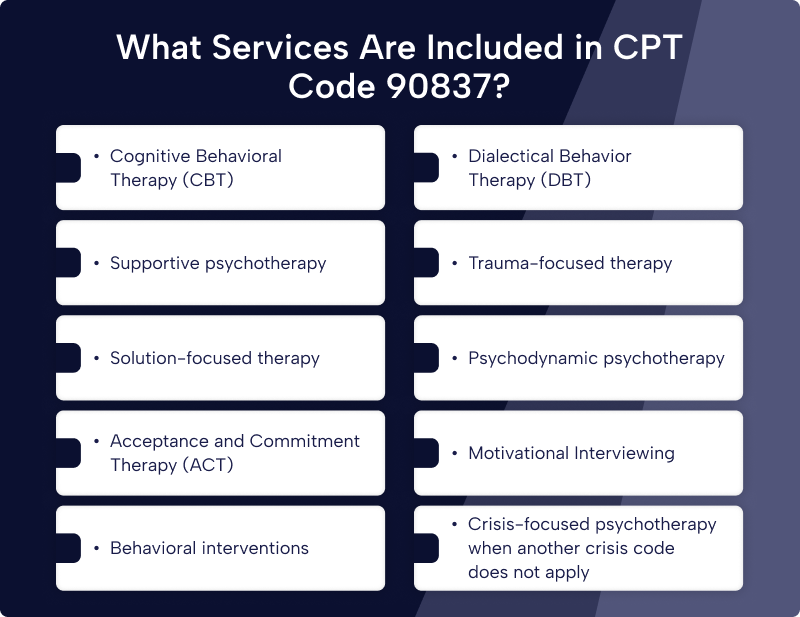
A 60-minute psychotherapy session may include a variety of therapeutic interventions based on the patient’s diagnosis and treatment goals.
Examples include:
- Cognitive Behavioral Therapy (CBT)
- Dialectical Behavior Therapy (DBT)
- Supportive psychotherapy
- Trauma-focused therapy
- Solution-focused therapy
- Psychodynamic psychotherapy
- Acceptance and Commitment Therapy (ACT)
- Motivational Interviewing
- Behavioral interventions
- Crisis-focused psychotherapy when another crisis code does not apply
The specific intervention should match the patient’s documented clinical needs and treatment plan.
Documentation Requirements for CPT Code 90837
Complete documentation is essential for demonstrating medical necessity and supporting reimbursement.
A well-documented psychotherapy note should generally include:
Patient Information
Document:
- Patient’s name
- Date of service
- Provider’s name and credentials
Session Length
Record the actual psychotherapy time.
For example:
Psychotherapy provided from 2:00 PM to 2:58 PM (58 minutes).
Avoid vague entries such as:
“One-hour therapy session.”
Specific start and stop times or total documented psychotherapy time provide stronger support during claim reviews and audits.
Clinical Presentation
Describe the patient’s current symptoms and clinical status.
Examples include:
- Anxiety symptoms
- Depressed mood
- Panic attacks
- Sleep disturbance
- Emotional dysregulation
- Functional impairment
- Stressors affecting treatment
Document findings that support the medical necessity of continued psychotherapy.
Therapeutic Interventions
Explain the interventions you used during the session.
Examples include:
- Cognitive restructuring
- Behavioral activation
- Exposure exercises
- Coping skills training
- Mindfulness techniques
- Trauma processing
- Communication skills training
- Emotional regulation strategies
Avoid generic statements such as:
“Provided therapy.”
Instead, clearly document what therapeutic techniques you used and why.
Patient Response
Describe how the patient responded to treatment.
Examples include:
- Demonstrated improved insight
- Practiced coping strategies
- Identified cognitive distortions
- Reported decreased anxiety
- Remained engaged throughout the session
Patient progress supports continued medical necessity.
Treatment Plan
Document:
- Goals discussed
- Homework assigned
- Planned interventions
- Follow-up schedule
- Changes to the treatment plan, if any
Provider Authentication
Complete the note with your signature and credentials according to payer requirements.
CPT Code 90837 Reimbursement Rates for 2026
One of the most common questions therapists ask is:
“How much does CPT Code 90837 reimburse?”
The answer depends on the insurance payer.
Medicare publishes its payment rates annually through the Medicare Physician Fee Schedule. Commercial insurers, including Cigna, Aetna, UnitedHealthcare, Optum, and Blue Cross Blue Shield, negotiate reimbursement rates individually with participating providers. As a result, there is no universal payment amount for CPT 90837.
Below is an overview of Medicare reimbursement and commercial insurance payment benchmarks for 2026.
Medicare Reimbursement for CPT Code 90837
For Calendar Year 2026, the national Medicare Physician Fee Schedule lists an average non-facility allowable amount of approximately $167.00 for CPT Code 90837 before geographic adjustments.
Keep in mind that Medicare payments vary because they incorporate Geographic Practice Cost Indices (GPCIs). A provider practicing in New York City, for example, may receive a different payment than a provider in rural Kansas, even when billing the same CPT code.
2026 Medicare Benchmark
| CPT Code | Service | Approximate National Medicare Rate* |
| 90837 | Individual Psychotherapy, 60 minutes | $167.00 |
*National average before locality adjustments. Actual Medicare reimbursement varies by locality and other payment policies.
Commercial Insurance Reimbursement
Unlike Medicare, commercial insurance companies negotiate reimbursement through individual provider contracts.
Several factors influence payment, including:
- Geographic location
- Individual provider agreement
- Group practice contract
- Provider credentials
- Network participation
- Patient benefit design
Because every contract differs, commercial reimbursement varies considerably.
Industry reimbursement analyses generally show that contracted commercial payments for CPT 90837 often exceed Medicare reimbursement, although the percentage varies by payer and market.
Estimated Commercial Benchmark
| Insurance Type | Estimated Reimbursement |
| Medicare | Approximately $167 |
| Commercial Insurance | Often higher than Medicare depending on the provider contract |
These figures are intended only as general market benchmarks. Your actual reimbursement depends on your negotiated agreement with the payer.
Estimated Reimbursement by Major Insurance Companies
Many therapists compare reimbursement across major commercial insurers before joining provider networks.
Although insurers do not publish national fee schedules, independent reimbursement analyses suggest the following approximate market ranges for many contracted providers.
| Insurance Company | Estimated CPT 90837 Reimbursement** |
| Cigna | Approximately $185-$250 |
| Aetna | Approximately $180-$245 |
| UnitedHealthcare | Approximately $180-$250 |
| Optum Behavioral Health | Approximately $180-$245 |
| Blue Cross Blue Shield | Varies significantly by state and plan |
These figures represent estimated commercial reimbursement benchmarks derived from independent market analyses and publicly available transparency data. They are not official fee schedules or guaranteed payment amounts. Actual reimbursement depends on provider contracts, geographic location, specialty, and the patient’s benefit plan.
Factors That Affect Your Reimbursement
Even therapists working in the same city may receive different payments for CPT 90837.
Several factors influence reimbursement.
Provider Credentials
Insurance companies often negotiate different reimbursement rates for different provider types.
Examples include:
- Psychiatrist
- Clinical Psychologist
- Licensed Clinical Social Worker
- Licensed Professional Counselor
- Licensed Marriage and Family Therapist
- Psychiatric Mental Health Nurse Practitioner
Some payer contracts reimburse doctoral-level providers differently from master’s-level clinicians.
Geographic Location
Healthcare costs differ across the country.
Urban markets with higher operating expenses frequently have higher contracted reimbursement than rural markets.
Individual Provider Contract
Your participating provider agreement remains the single biggest factor affecting reimbursement.
Providers who renegotiate contracts periodically may receive higher reimbursement than providers with older agreements.
Network Status
In-network providers receive reimbursement according to their negotiated contract.
Out-of-network reimbursement depends on the patient’s benefits and the plan’s allowable amount. Providers generally collect payment from the patient and may provide a superbill if the patient plans to seek reimbursement.
Does Telehealth Affect Reimbursement?
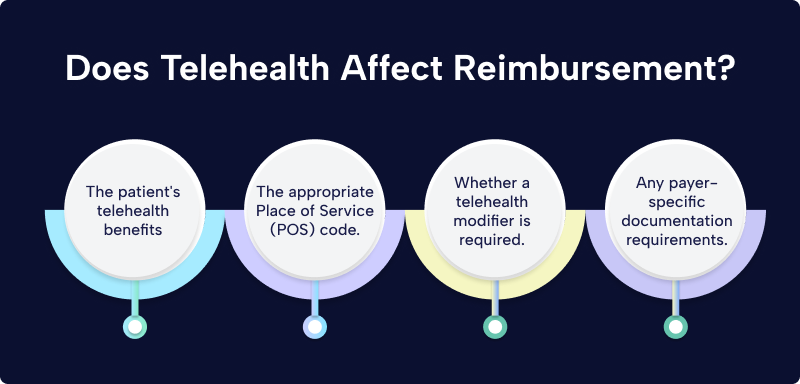
Many insurance companies continue to cover telehealth psychotherapy, but payment policies vary.
Before billing CPT 90837 through telehealth, verify:
- The patient’s telehealth benefits.
- The appropriate Place of Service (POS) code.
- Whether a telehealth modifier is required.
- Any payer-specific documentation requirements.
Following current payer guidance helps reduce claim denials.
Common Reasons CPT 90837 Claims Are Denied
Because CPT 90837 represents the longest routine psychotherapy session, insurers often review these claims carefully.
Common denial reasons include:
- Insufficient documented psychotherapy time.
- Documentation that does not support medical necessity.
- Incorrect CPT code selection.
- Missing or invalid modifiers.
- Expired patient eligibility.
- Missing prior authorization when required.
- Claims filed after the timely filing deadline.
- Billing errors involving the rendering provider or NPI.
Reviewing documentation before claim submission can improve first-pass payment rates.
Best Practices for Billing CPT Code 90837
To improve reimbursement and reduce denials:
- Document at least 53 minutes of psychotherapy.
- Clearly establish medical necessity.
- Describe the therapeutic interventions performed.
- Record patient progress toward treatment goals.
- Verify insurance eligibility before every visit.
- Confirm prior authorization requirements when applicable.
- Submit claims promptly.
- Review Explanation of Payment (EOP) statements for underpayments or coding errors.
- Maintain documentation that supports the billed service in case of an audit.
Accurate coding, thorough documentation, and proactive verification can significantly improve reimbursement while helping your practice remain compliant with payer requirements.
Conclusion
CPT Code 90837 can support strong reimbursement when providers meet the required time, documentation, coding, and payer guidelines. Accurate session records, clear medical necessity, eligibility checks, and timely claim submission can help reduce denials and payment delays. Since reimbursement varies by payer and contract, always verify current requirements and rates before billing.
Managing psychotherapy billing, payer rules, documentation, and denials can take valuable time away from patient care. Mental Health Billing Service (MHBS) helps behavioral health providers manage the billing process, improve claim accuracy, reduce denials, and protect revenue.
Need help with your mental health billing?
Contact MHBS today to improve your billing process and maximize the reimbursement.
Frequently Asked Questions (FAQs)
What is CPT Code 90837?
CPT Code 90837 reports individual psychotherapy lasting 60 minutes, with a documented psychotherapy time of 53 minutes or longer. Qualified behavioral health professionals use this code to bill ongoing one-on-one psychotherapy sessions for the diagnosis and treatment of mental health conditions.
What is the Medicare reimbursement rate for CPT 90837 in 2026?
For 2026, the national average Medicare non-facility allowable amount for CPT 90837 is approximately $167.00 before geographic adjustments.
Actual Medicare reimbursement varies because CMS adjusts payments using Geographic Practice Cost Indices (GPCIs). Your locality and Medicare Administrative Contractor (MAC) determine your final payment amount.
How much do commercial insurance companies reimburse for CPT 90837?
Commercial insurance reimbursement varies by payer and provider contract.
Many contracted commercial plans reimburse more than Medicare, but there is no standard national rate. Your reimbursement depends on factors such as:
- Your negotiated contract
- Geographic location
- Provider credentials
- Insurance company
- Patient’s health plan
- Network participation
Always refer to your contracted fee schedule or Explanation of Payment (EOP) for your actual reimbursement amount.
Can CPT 90837 be billed through telehealth?
Yes.
Medicare and many commercial insurers cover CPT 90837 when the psychotherapy session meets telehealth billing requirements. Report the appropriate Place of Service (POS) code and any required telehealth modifier according to the payer’s billing guidelines. Always verify payer-specific requirements because modifier and POS rules can vary.
Which modifiers are commonly used with CPT 90837?
The required modifier depends on the payer and the circumstances of the service.
Common modifiers include:
- 95 – Synchronous telehealth service (used by many commercial payers)
- 93 – Audio-only telehealth service when allowed by payer policy
- HO – Master’s degree level provider, when required by specific commercial payer policies
- AH – Clinical psychologist, when required by certain payer-specific billing rules
Do not append modifiers unless payer policy supports their use.
Can CPT 90837 and 90792 be billed on the same day?
Yes, in certain situations.
When the same provider performs both a psychiatric diagnostic evaluation with medical services (90792) and a medically necessary psychotherapy service on the same date, some payers allow both services if documentation clearly supports each service as separate and distinct. However, many payers have edits or additional documentation requirements.
Always verify the payer’s billing policy before submitting both codes on the same claim.