
Telehealth has become an important part of behavioral health care, but billing virtual services can be challenging because Modifier 95, Modifier GT, POS 10, and POS 02 each communicate different information on a claim.
While Modifier 95 generally identifies synchronous audio/video telehealth, POS 10 and POS 02 identify whether the patient received the service at home or another location, and Modifier GT has limited use under current Medicare rules.
Understanding these differences is essential for behavioral health providers and billing teams to select the correct codes, follow payer-specific requirements, avoid outdated billing practices, and reduce claim errors and denials in 2026.
Modifier 95 vs. GT vs. POS 10 vs. POS 02
The easiest way to understand these four reporting elements is to assign each one a job.
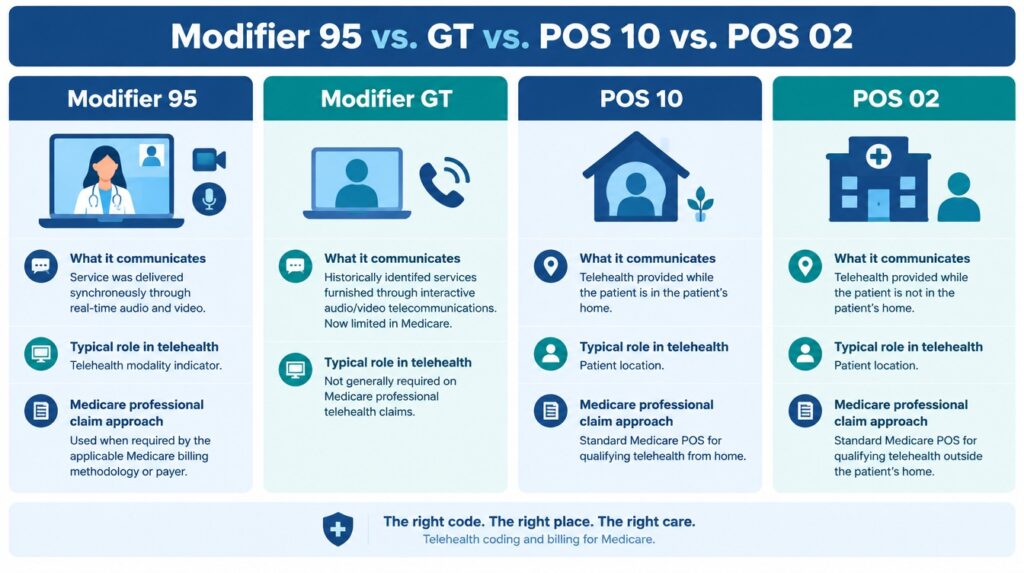
CMS defines POS 02 as Telehealth Provided Other than in Patient’s Home and POS 10 as Telehealth Provided in Patient’s Home. CMS introduced the separate POS 10 reporting approach effective January 1, 2024, and Medicare pays qualifying home telehealth services at the non-facility PFS rate.
Remember that POS 02 and POS 10 tell the payer where the patient was located, while a modifier such as 95 communicates information about how the service was delivered.
That is why saying “use Modifier 95 instead of POS 10” is usually an oversimplification.
Why Behavioral Health Providers Need to Get This Right
Behavioral health makes telehealth coding particularly important because virtual delivery is now routine for psychotherapy, psychiatric evaluation, medication management and other mental health services.
A typical encounter might look like this:
A licensed clinician provides a 53-minute psychotherapy session. The clinician is working from the office. The patient is sitting at home. The visit occurs through a secure, real-time audio/video platform.
The clinical service itself is represented by the appropriate CPT code.
The telehealth reporting elements then tell the payer that the encounter occurred remotely and identify the patient’s location.
For a Medicare professional claim, the location is generally reported with POS 10 when the patient is at home. If the patient is receiving the service from another location, such as a physician office, outpatient facility or other qualifying location, POS 02 may apply.
The mistake occurs when a billing team treats 95, GT and POS codes as competing versions of the same thing.
They are not.
What Is Modifier 95?
Modifier 95 identifies a synchronous telemedicine service rendered through a real-time interactive audio and video telecommunications system.
In practical terms, it tells the payer that the clinician and patient interacted in real time using audio and video technology.
This makes Modifier 95 especially relevant to video-based behavioral health services.
Examples can include:
- Individual psychotherapy
- Family psychotherapy
- Group psychotherapy
- Psychiatric evaluation
- Certain psychiatric or behavioral health E/M services
- Other eligible services when the payer permits telehealth delivery
However, Modifier 95 does not independently establish that the service is payable.
The underlying CPT or HCPCS code must be eligible under the payer’s telehealth policy, the provider must be eligible to furnish the service, the technology must satisfy applicable requirements, and documentation must support the service.
In other words:
95 tells the payer about the delivery method. It does not turn an otherwise non-covered service into a covered telehealth service.
CMS currently uses Modifier 95 explicitly for certain RHC and FQHC telehealth claims. Beginning October 1, 2026, RHCs and FQHCs billing distant-site telehealth services use the individual CPT or HCPCS code describing the service together with the appropriate telehealth modifier. CMS identifies Modifier 95 for synchronous audio/video services and Modifier 93 for synchronous audio-only services in that setting.
That does not mean every Medicare professional behavioral health claim should automatically carry Modifier 95.
The claim structure matters.
When Is Modifier 95 Used for Behavioral Health?
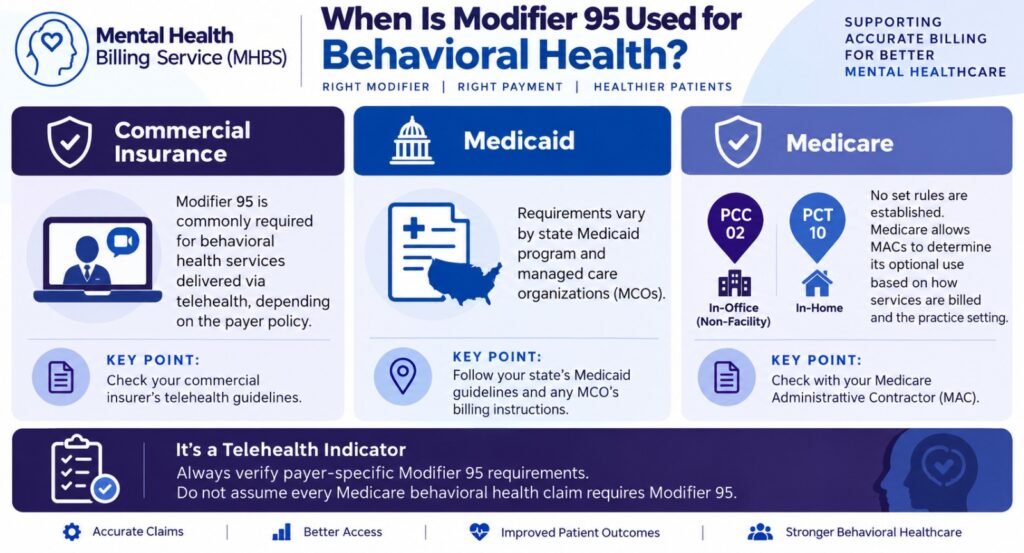
The answer depends on the payer and claim type.
For commercial insurance, Modifier 95 is commonly required or accepted for synchronous video telehealth, but individual payer policies can differ.
For Medicaid, the state Medicaid agency and the managed care organization may establish their own billing rules.
For Medicare professional claims, POS 02 and POS 10 are the primary location indicators for telehealth under the current professional billing framework. CMS specifically instructs physicians and practitioners to use POS 02 when the patient is not at home and POS 10 when the patient is at home.
Therefore, a behavioral health billing team should not create a blanket rule such as:
“Every Medicare telehealth claim requires Modifier 95.”
That rule is too broad.
Instead, the organization should identify the payer’s current claim instructions and determine whether Modifier 95 is required in addition to the applicable POS.
What Is Modifier GT?
Modifier GT is one of the most commonly misunderstood telehealth modifiers.
Historically, Medicare used GT to identify professional telehealth services furnished through an interactive audio and video telecommunications system. The modifier also functioned as a certification that the beneficiary was located at an eligible originating site under the older Medicare telehealth framework.
That is no longer the general Medicare professional billing rule.
CMS eliminated the requirement to use Modifier GT on professional claims for telehealth services effective January 1, 2018. CMS stated that the telehealth POS code 02 would instead certify that the service met the applicable telehealth requirements.
This historical change is the reason older billing articles can create problems for today’s billing staff.
A resource written before 2018 may tell providers to append GT to a Medicare telehealth claim. That instruction may have been accurate under the older framework but does not represent the current general Medicare professional claim rule.
Does Medicare Still Use Modifier GT?
Yes, but not as the general professional telehealth modifier it once was.
CMS continues to identify a limited situation in which GT is used for telehealth claims. The current Medicare telehealth guidance states that distant-site practitioners billing telehealth under the critical access hospital optional payment Method II must submit institutional claims using Modifier GT.
That is a very different scenario from an ordinary outpatient behavioral health professional claim.
For a typical behavioral health clinician submitting a professional claim to Medicare, GT should not be added simply because the encounter occurred by video.
The practical rule
If your billing team sees an older workflow that says:
Telehealth = add GT
do not adopt that rule without checking the current payer instructions.
For standard Medicare professional telehealth billing, the general GT requirement was eliminated years ago.
Modifier 95 vs. Modifier GT
The difference can be summarized as follows:
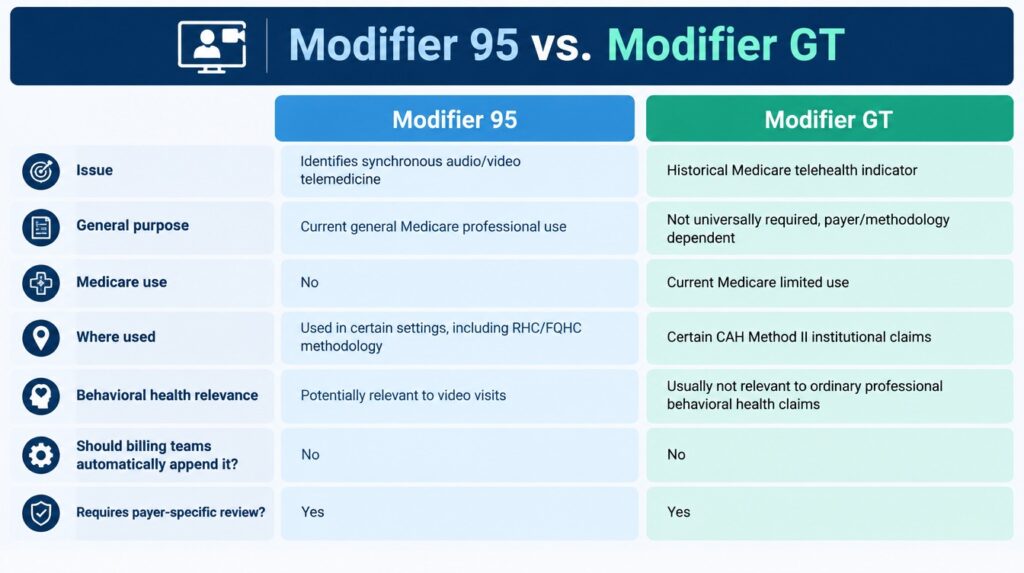
The important lesson is not that 95 is “the new GT.”
That phrase is too simplistic.
The two modifiers have different historical and current applications.
What Is POS 10?
POS 10 means:
Telehealth Provided in Patient’s Home.
CMS defines this as a location where health services are provided or received through telecommunications technology while the patient is in their home. CMS specifies that the home is a private residence other than a hospital or other facility where the patient receives care.
For behavioral health, POS 10 is highly relevant because Medicare permanently removed geographic and originating-site restrictions for behavioral health telehealth services. CMS states that beneficiaries can receive behavioral health telehealth services in their homes in both rural and urban areas.
That means a Medicare beneficiary does not need to travel to a clinic merely because the service is behavioral health.
Example of POS 10
A psychiatrist conducts a psychiatric evaluation by secure video.
The patient participates from a private residence.
The provider is at the practice office.
The claim should identify the appropriate behavioral health service code and, for Medicare professional billing, report POS 10 because the patient was in the home.
Whether Modifier 95 is also reported depends on the applicable billing methodology and payer requirements.
The POS code answers the location question.
What Is POS 02?
POS 02 means:
Telehealth Provided Other than in Patient’s Home.
CMS defines POS 02 as a location where health services are provided or received through telecommunications technology when the patient is not in their home.
Consider a patient who visits a community behavioral health facility but meets with a psychiatrist located at another site through secure video.
The patient is not in a private residence.
POS 02 can identify the telehealth location in this situation for Medicare professional billing.
Other examples may include a patient receiving a telehealth service from an eligible facility or other non-home setting, subject to payer policy.
POS 10 vs. POS 02
The key differencebetween POS and POS 02 is:
- Patient at home = POS 10
- Patient somewhere other than home = POS 02
The provider’s physical location does not determine whether the claim uses POS 10 or POS 02.
The patient’s location does.
This is an important point for behavioral health organizations with clinicians working remotely.
Suppose the clinician works from home while treating a patient who is also at home.
The clinician’s home does not make the claim POS 10.
POS 10 is based on the patient’s location.
Likewise, if a clinician works from an office while the patient is at home, the claim can still use POS 10.
Why POS 10 Matters for Medicare Payment
POS is not merely descriptive.
It can affect Medicare payment.
CMS states that beginning January 1, 2024, Medicare pays telehealth services provided to patients in their homes at the non-facility Physician Fee Schedule rate.
That makes accurate POS reporting important for revenue-cycle management.
If a behavioral health practice routinely reports POS 02 for patients who were actually at home, the issue is not simply that the claim contains the wrong two-digit code. The incorrect POS can affect payment logic and trigger claim edits.
For this reason, the patient-location field in the EHR should be treated as a billing data element, not just a scheduling detail.
A Simple Claim Process for Behavioral Health Telehealth
A useful way to structure the claim is:
Step 1: Identify the service.
Select the CPT or HCPCS code that accurately represents the behavioral health service performed.
Step 2: Confirm telehealth eligibility.
Verify that the payer covers the service when delivered through the applicable telehealth modality.
Step 3: Determine the patient’s location.
If the patient was at home, consider POS 10.
If the patient was somewhere other than home, consider POS 02.
Step 4: Determine the technology used.
If the service was synchronous audio/video, determine whether the payer requires Modifier 95.
If the encounter was audio-only, do not automatically use 95. A different code or modifier may apply depending on the payer.
Step 5: Check payer-specific rules.
Medicare, Medicaid and commercial insurers may use different reporting requirements.
Step 6: Verify documentation.
The record should support the service, medical necessity, participants, date, duration or other applicable coding requirements, and the telehealth modality when required.
This workflow is much safer than telling billers to attach 95 or GT to every virtual encounter.
Medicare Behavioral Health Telehealth in 2026
Medicare’s behavioral health telehealth rules deserve separate attention because Congress and CMS have made behavioral health an important exception within the broader telehealth framework.
CMS states that geographic and place-of-service restrictions were permanently removed for behavioral health telehealth services. Beneficiaries can receive behavioral health telehealth services at home, including in rural and urban locations. CMS also permits two-way interactive audio-only technology for behavioral health telehealth services under applicable rules.
This is why an older statement such as “Medicare telehealth requires the patient to be in a rural originating site” is misleading when applied broadly to behavioral health in 2026.
The rule needs to be separated by service category.
Behavioral health is treated differently
CMS specifically states that the telehealth geographic and originating-site limitations do not apply to behavioral health services in the same way they apply to many other Medicare telehealth services.
That is particularly important for:
- Mental health services
- Behavioral health treatment
- Substance use disorder services
- Certain psychotherapy services
- Other qualifying behavioral health encounters
However, the service must still satisfy all other applicable Medicare coverage, coding, practitioner eligibility and documentation requirements.
Telehealth flexibility does not eliminate medical necessity requirements.
The 2026 In-Person Mental Health Requirement Needs Careful Handling
One of the most important changes for 2026 involves the statutory in-person requirements associated with Medicare mental health services furnished through telecommunications technology.
CMS’s published materials have reflected a requirement for an in-person mental health service within six months before telehealth mental health treatment and at least every 12 months thereafter, subject to an exception when the clinician and patient determine that the risks and burdens outweigh the benefits and the clinician documents the decision.
However, subsequent federal legislation in 2026 delayed implementation of the in-person requirements. The 2026 legislative language moved the effective date from January 31, 2026 to January 1, 2028. CMS’s 2027 proposed rule likewise describes the 2026 legislation as requiring the in-person visit requirements for mental health telehealth to remain inapplicable through December 31, 2027.
For a 2026 billing article, this distinction matters.
A billing guide should not simply repeat an older CMS manual paragraph and state that every Medicare behavioral health telehealth patient must complete an in-person visit during 2026.
Organizations should follow the current CMS implementation guidance and applicable legislation for the date of service.
Modifier 95 and POS 10: Are They Both Needed?
This is one of the most common questions.
The answer is:
Sometimes, but not automatically for Medicare professional claims.
POS 10 identifies the patient’s home as the telehealth location.
Modifier 95 identifies synchronous audio/video telemedicine when the applicable payer or billing methodology requires that modifier.
A commercial payer might instruct a behavioral health provider to report:
CPT code + POS 10 + Modifier 95
for a video visit with a patient at home.
Another payer might instruct the provider to use:
CPT code + POS 10
without 95.
Medicare’s professional telehealth framework uses POS 10 and POS 02 to identify the location. CMS’s current telehealth materials also show that Modifier 95 remains relevant in specific billing arrangements, including RHC/FQHC telehealth reporting and other defined circumstances.
Therefore, the claim should follow the payer’s current instructions rather than a universal combination rule.
Can You Bill POS 10 With Modifier GT?
For ordinary Medicare professional behavioral health claims, this should not be treated as a standard combination.
GT was eliminated as a general professional Medicare telehealth requirement in 2018.
If a payer contract or state Medicaid program specifically requires GT, the provider should follow that payer’s policy.
But a behavioral health practice should not create an internal rule such as:
“All home telehealth visits use POS 10 + GT.”
That rule confuses an older Medicare reporting convention with current claim requirements.
Can You Bill POS 02 With Modifier 95?
Yes, when the payer’s policy calls for Modifier 95 and the encounter meets the definition of synchronous audio/video telehealth.
For example, a patient receives psychotherapy from a community facility while the behavioral health clinician participates from another location through real-time audio/video.
The patient is not at home, so POS 02 may apply.
If the payer requires Modifier 95 for the video encounter, the claim may report the service with POS 02 and Modifier 95.
But again, payer instructions control.
The important point is that POS 02 and Modifier 95 answer different questions.
POS 02 answers:
Where was the patient receiving telehealth?
Modifier 95 answers:
Was the service delivered synchronously through real-time audio/video technology?
Commercial Payers: Why the Rules Can Differ
Commercial payer policies often retain telehealth reporting conventions that do not exactly mirror Medicare.
A payer may require:
- POS 02
- POS 10
- Modifier 95
- A combination of POS and Modifier 95
- Another telehealth modifier
- Payer-specific telehealth codes
- A particular claim form or electronic claim configuration
Some commercial plans also distinguish between audio/video and audio-only encounters.
That means a behavioral health organization’s payer matrix should never have a single line that says:
Telehealth = Modifier 95
Instead, the matrix should identify the requirement by payer and product.
A useful structure is:
| Payer | Patient home | Patient non-home | Video | Audio-only | Modifier | Notes |
| Medicare | POS 10 | POS 02 | Verify current telehealth eligibility | Separate rules | Payer-specific | Follow current CMS guidance |
| Medicaid | State/payer rule | State/payer rule | State/payer rule | State/payer rule | State/payer rule | Check state Medicaid and MCO |
| Commercial Plan A | Payer rule | Payer rule | Payer rule | Payer rule | Payer rule | Contract controls |
| Commercial Plan B | Payer rule | Payer rule | Payer rule | Payer rule | Payer rule | Verify current policy |
This approach is more useful than memorizing a single modifier.
Medicaid Behavioral Health Telehealth Billing
Medicaid is especially important because there is no single nationwide Medicaid telehealth billing rule.
Federal Medicaid policy provides states with flexibility, and individual state Medicaid agencies determine many telehealth coverage and billing requirements within the applicable federal framework.
Managed care organizations can also publish plan-specific billing instructions.
Therefore, a behavioral health provider billing Medicaid should identify:
- The state Medicaid program.
- Whether the claim is fee-for-service or managed care.
- The provider type.
- The behavioral health service.
- Whether the service is video or audio-only.
- The required POS.
- The required modifier.
- Any telehealth documentation requirements.
A modifier that is correct for a commercial payer in one state may not be correct for the state’s Medicaid program.
This is one reason national telehealth billing articles should avoid statements such as “Medicaid requires Modifier 95.”
Medicaid does not operate under one universal claim-level telehealth rule across all states and plans.
Behavioral Health Services Commonly Billed Through Telehealth
Telehealth can apply to a range of behavioral health services, but eligibility depends on the payer and service.
Common examples include:
Psychotherapy
Behavioral health practices frequently provide individual, family and group psychotherapy through synchronous video.
The provider must report the appropriate psychotherapy CPT code based on the service performed and applicable coding rules.
Telehealth reporting then communicates the remote delivery method and patient location.
Psychiatric Diagnostic Evaluation
Psychiatric diagnostic evaluations may be furnished through telehealth when the payer permits the service and the clinician meets the applicable requirements.
The claim should not use a generic “telehealth code” instead of the CPT code describing the actual professional service.
Medication Management and E/M
Psychiatrists and other eligible practitioners may provide certain E/M services through telehealth when the payer permits them.
The appropriate E/M code should be selected based on the service and the applicable coding guidelines.
Substance Use Disorder Services
Telehealth can also play an important role in behavioral health and substance use disorder treatment.
Medicare has specific telehealth rules for opioid treatment programs and certain SUD services. For example, CMS instructs OTPs to use POS 58 for OTP services, including services delivered through audio/video or audio-only technology, with Modifier 95 or 93 for specified counseling and therapy codes depending on the technology used.
This illustrates why providers should not assume that POS 10 or POS 02 applies to every behavioral health telehealth service.
The service setting and billing methodology can override the general professional telehealth pattern.
Documentation Requirements for Telehealth Behavioral Health
Correct modifiers and POS codes cannot rescue weak documentation.
The medical record should support the underlying service and, when applicable, the telehealth method.
A strong telehealth note generally establishes:
- Date of service
- Patient identity
- Provider identity
- Service performed
- Clinical reason for the encounter
- Relevant assessment
- Intervention or treatment provided
- Medical necessity
- Patient response when applicable
- Plan or follow-up
- Duration or other elements required by the selected code
- Telehealth modality when relevant
- Patient location when required
- Provider location when required by the payer
- Participants in the encounter when applicable
- Any consent or telehealth attestation required by the payer
The exact documentation requirements vary by service and payer.
The note should support what the claim says.
If the claim reports POS 10 but the record consistently identifies the patient as being in a residential treatment facility, the organization has a data integrity problem.
If the claim reports video telehealth but the note documents a telephone-only encounter, the claim and record do not tell the same story.
Patient Location Should Come from the Encounter Workflow
One practical improvement is to capture the patient’s location during check-in.
The EHR can ask:
Where are you physically located today?
Possible responses can then map to the appropriate billing workflow.
For example:
- Private residence → candidate for POS 10
- Clinic/facility → candidate for POS 02 when telehealth is being received there
- Hospital → payer-specific review
- Other facility → payer-specific review
The system should not infer the patient’s location from the provider’s address.
That is one of the most common sources of incorrect POS reporting.
Common Telehealth Behavioral Health Billing Errors
Treating Modifier 95 and POS 10 as Alternatives
They are not simply alternatives.
POS 10 describes the patient’s location.
Modifier 95 describes synchronous audio/video telemedicine.
A payer may require one, both or neither depending on the claim methodology.
Correction
Build the claim logic around separate questions:
- Where was the patient?
- How was the service delivered?
Then apply the payer’s reporting rules.
Using GT Because an Old Cheat Sheet Says “Telehealth = GT”
This is one of the clearest outdated billing practices.
CMS eliminated the general requirement for GT on Medicare professional telehealth claims effective January 1, 2018.
Correction
Remove outdated GT instructions from Medicare professional behavioral health billing guides unless the organization has a specific claim type for which CMS still requires GT.
Using POS 02 for Every Telehealth Encounter
POS 02 is not the universal telehealth POS code.
CMS created POS 10 specifically for telehealth delivered to a patient in the patient’s home.
Correction
Ask where the patient was physically located at the time of the encounter.
Home generally points to POS 10.
Non-home telehealth generally points to POS 02 under the Medicare professional framework.
Using POS 10 Because the Provider Worked From Home
The POS code describes the patient’s location, not the provider’s location.
Correction
Capture patient location separately from provider location.
Assuming Medicare and Commercial Payers Use the Same Telehealth Rules
They do not necessarily.
A commercial plan may require Modifier 95 when Medicare does not require it on the same type of professional claim.
Correction
Maintain payer-specific billing rules.
Adding a Telehealth Modifier Without Checking Service Eligibility
Modifier 95 does not make a non-covered service payable.
Correction
First verify:
- CPT/HCPCS eligibility
- Provider eligibility
- Payer coverage
- Technology requirements
- Patient eligibility
- Documentation requirements
Then apply the telehealth reporting elements.
Ignoring Audio-Only Rules
Modifier 95 describes synchronous audio/video. It should not automatically be used for an audio-only encounter.
CMS now uses Modifier 93 for certain synchronous audio-only telehealth claims, including the current RHC/FQHC methodology.
Commercial and Medicaid requirements can differ.
Correction
Create a separate audio-only workflow rather than treating it as a variation of video telehealth.
How RCM Teams Should Configure Their Telehealth Billing Rules
The best telehealth workflow is not a single modifier rule. It is a set of payer-specific claim rules.
A behavioral health organization should maintain at least these fields:
| Data element | Example |
| Payer | Medicare |
| Product | Original Medicare |
| Service | Psychotherapy |
| Modality | Audio/video |
| Patient location | Home |
| POS | 10 |
| Modifier | Based on current payer rule |
| CPT/HCPCS | Appropriate service code |
| Documentation | Telehealth note |
| Eligibility | Confirmed |
| Coverage | Confirmed |
For commercial plans, the same table can show whether Modifier 95 is required.
For Medicaid managed care, the matrix should identify the specific state and MCO.
This approach is far more reliable than asking individual billers to remember which modifier “usually” applies.
Claim Scrubbing Rules for Telehealth Behavioral Health
An effective claim scrubber can catch several preventable errors before submission.
Useful edits include:
Edit 1: POS 10 with missing telehealth indicators
If the payer requires a telehealth modifier in addition to POS 10, flag the claim before submission.
Edit 2: GT on standard Medicare professional behavioral health claims
Flag GT for review rather than automatically deleting it. The purpose is to determine whether a special billing methodology applies.
Edit 3: POS 02 for documented home encounter
If the encounter workflow identifies the patient as being at home but the claim contains POS 02, route it for review.
Edit 4: Modifier 95 on audio-only encounter
Flag a claim carrying 95 when the encounter record indicates telephone-only delivery.
Edit 5: Missing patient location
Require the location field before releasing a telehealth claim.
Edit 6: Payer mismatch
If a commercial payer requires 95 but the Medicare rule set does not, the claim scrubber should apply the correct payer-specific configuration.
These edits turn telehealth coding from a memory exercise into a controlled revenue-cycle process.
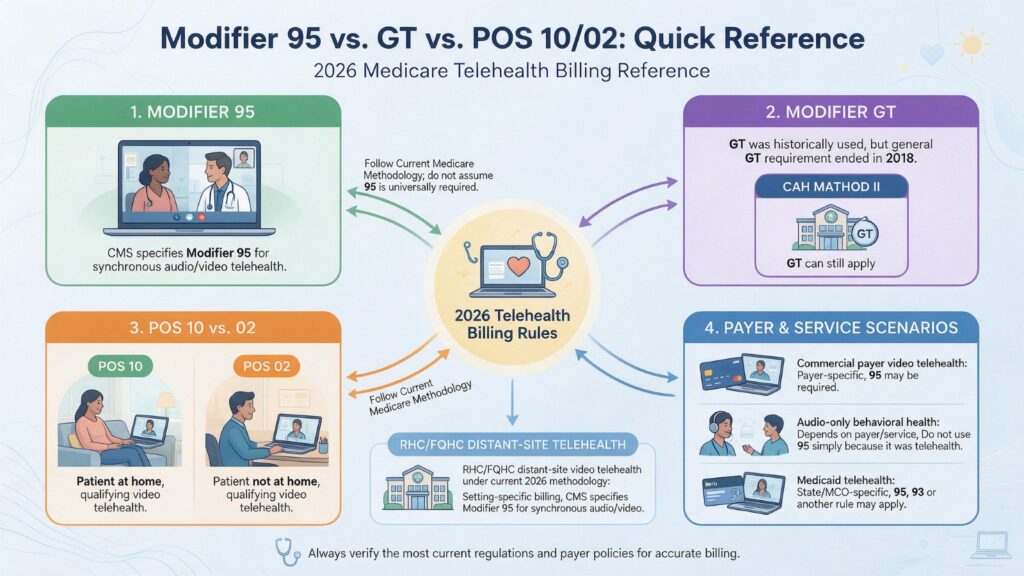
Modifier 95 vs. GT vs. POS 10/02: Quick Reference
The table should be used as a starting point, not as a substitute for the payer’s current billing manual.
Final Verdict
Modifier 95, Modifier GT, POS 10, and POS 02 are not four interchangeable ways of saying “telehealth.”
They represent different pieces of claim information.
- Modifier 95 identifies synchronous telemedicine delivered through real-time audio and video when the applicable payer or billing methodology requires that modifier.
- Modifier GT is largely a historical Medicare professional telehealth modifier. CMS eliminated the general GT requirement for professional claims in 2018, although GT remains applicable in specific situations such as certain CAH Method II institutional claims.
- POS 10 identifies telehealth provided while the patient is in the patient’s home.
- POS 02 identifies telehealth provided while the patient is somewhere other than the patient’s home.
For behavioral health billing in 2026, the safest workflow is to determine the service first, verify telehealth eligibility, identify the patient’s actual location, determine whether the encounter was video or audio-only, and then apply the payer’s reporting requirements.
For Medicare professional claims, POS 10 and POS 02 are central to the current telehealth location framework. Behavioral health also receives important telehealth flexibility, including the ability to furnish qualifying services to beneficiaries in their homes.
At the same time, commercial insurance, Medicaid programs and managed care organizations can use different combinations of POS codes and modifiers. A billing policy that works for one payer should not automatically become the rule for every other payer.
The most reliable telehealth claim is therefore not the one carrying the most codes. It is the one where the CPT or HCPCS code, patient location, telehealth modality, payer rules and documentation all describe the same encounter.