


 Talk to an Expert
Telehealth has become an important part of behavioral health care, but billing virtual services can be challenging because Modifier 95, Modifier GT, POS 10, and POS 02 each communicate different information on a claim.
While Modifier 95 generally identifies synchronous audio/video telehealth, POS 10 and POS 02 identify whether the patient received the service at home or another location, and Modifier GT has limited use under current Medicare rules.
Understanding these differences is essential for behavioral health providers and billing teams to select the correct codes, follow payer-specific requirements, avoid outdated billing practices, and reduce claim errors and denials in 2026.
The easiest way to understand these four reporting elements is to assign each one a job.
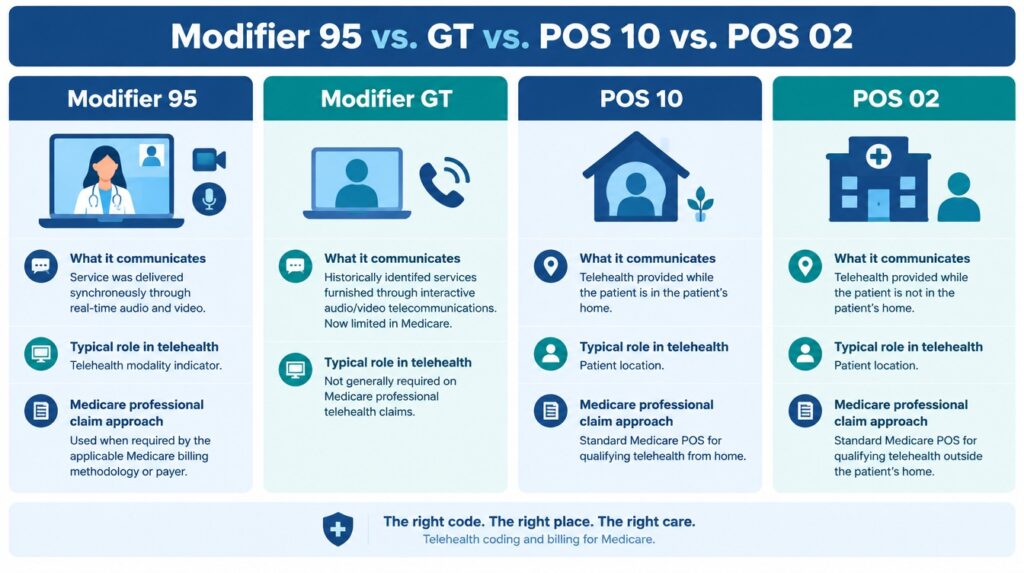
CMS defines POS 02 as Telehealth Provided Other than in Patient’s Home and POS 10 as Telehealth Provided in Patient’s Home. CMS introduced the separate POS 10 reporting approach effective January 1, 2024, and Medicare pays qualifying home telehealth services at the non-facility PFS rate.
Remember that POS 02 and POS 10 tell the payer where the patient was located, while a modifier such as 95 communicates information about how the service was delivered.
That is why saying “use Modifier 95 instead of POS 10” is usually an oversimplification.
Behavioral health makes telehealth coding particularly important because virtual delivery is now routine for psychotherapy, psychiatric evaluation, medication management and other mental health services.
A typical encounter might look like this:
A licensed clinician provides a 53-minute psychotherapy session. The clinician is working from the office. The patient is sitting at home. The visit occurs through a secure, real-time audio/video platform.
The clinical service itself is represented by the appropriate CPT code.
The telehealth reporting elements then tell the payer that the encounter occurred remotely and identify the patient’s location.
For a Medicare professional claim, the location is generally reported with POS 10 when the patient is at home. If the patient is receiving the service from another location, such as a physician office, outpatient facility or other qualifying location, POS 02 may apply.
The mistake occurs when a billing team treats 95, GT and POS codes as competing versions of the same thing.
They are not.
Modifier 95 identifies a synchronous telemedicine service rendered through a real-time interactive audio and video telecommunications system.
In practical terms, it tells the payer that the clinician and patient interacted in real time using audio and video technology.
This makes Modifier 95 especially relevant to video-based behavioral health services.
Examples can include:
However, Modifier 95 does not independently establish that the service is payable.
The underlying CPT or HCPCS code must be eligible under the payer’s telehealth policy, the provider must be eligible to furnish the service, the technology must satisfy applicable requirements, and documentation must support the service.
In other words:
95 tells the payer about the delivery method. It does not turn an otherwise non-covered service into a covered telehealth service.
CMS currently uses Modifier 95 explicitly for certain RHC and FQHC telehealth claims. Beginning October 1, 2026, RHCs and FQHCs billing distant-site telehealth services use the individual CPT or HCPCS code describing the service together with the appropriate telehealth modifier. CMS identifies Modifier 95 for synchronous audio/video services and Modifier 93 for synchronous audio-only services in that setting.
That does not mean every Medicare professional behavioral health claim should automatically carry Modifier 95.
The claim structure matters.
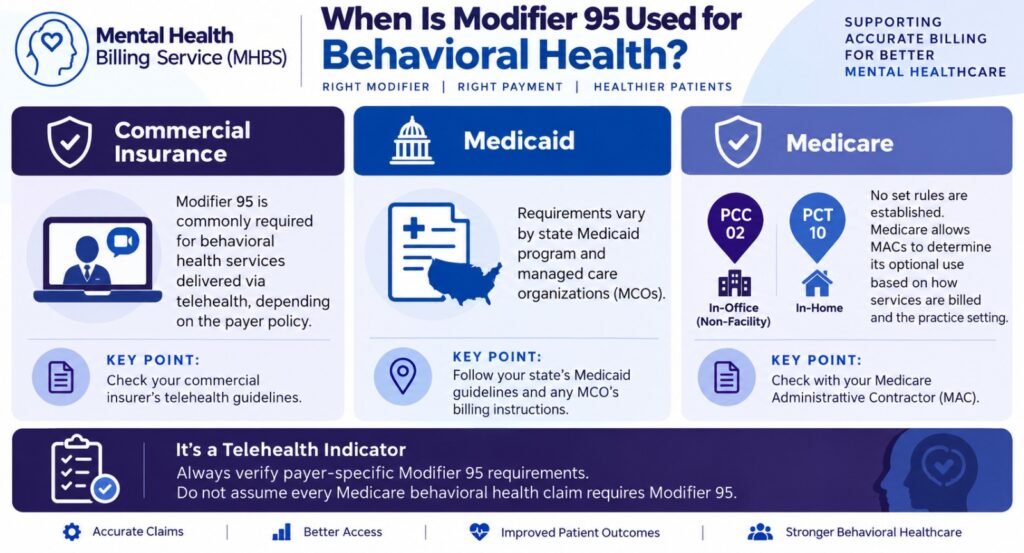
The answer depends on the payer and claim type.
For commercial insurance, Modifier 95 is commonly required or accepted for synchronous video telehealth, but individual payer policies can differ.
For Medicaid, the state Medicaid agency and the managed care organization may establish their own billing rules.
For Medicare professional claims, POS 02 and POS 10 are the primary location indicators for telehealth under the current professional billing framework. CMS specifically instructs physicians and practitioners to use POS 02 when the patient is not at home and POS 10 when the patient is at home.
Therefore, a behavioral health billing team should not create a blanket rule such as:
“Every Medicare telehealth claim requires Modifier 95.”
That rule is too broad.
Instead, the organization should identify the payer’s current claim instructions and determine whether Modifier 95 is required in addition to the applicable POS.
Modifier GT is one of the most commonly misunderstood telehealth modifiers.
Historically, Medicare used GT to identify professional telehealth services furnished through an interactive audio and video telecommunications system. The modifier also functioned as a certification that the beneficiary was located at an eligible originating site under the older Medicare telehealth framework.
That is no longer the general Medicare professional billing rule.
CMS eliminated the requirement to use Modifier GT on professional claims for telehealth services effective January 1, 2018. CMS stated that the telehealth POS code 02 would instead certify that the service met the applicable telehealth requirements.
This historical change is the reason older billing articles can create problems for today’s billing staff.
A resource written before 2018 may tell providers to append GT to a Medicare telehealth claim. That instruction may have been accurate under the older framework but does not represent the current general Medicare professional claim rule.
Yes, but not as the general professional telehealth modifier it once was.
CMS continues to identify a limited situation in which GT is used for telehealth claims. The current Medicare telehealth guidance states that distant-site practitioners billing telehealth under the critical access hospital optional payment Method II must submit institutional claims using Modifier GT.
That is a very different scenario from an ordinary outpatient behavioral health professional claim.
For a typical behavioral health clinician submitting a professional claim to Medicare, GT should not be added simply because the encounter occurred by video.
The practical rule
If your billing team sees an older workflow that says:
Telehealth = add GT
do not adopt that rule without checking the current payer instructions.
For standard Medicare professional telehealth billing, the general GT requirement was eliminated years ago.
The difference can be summarized as follows:
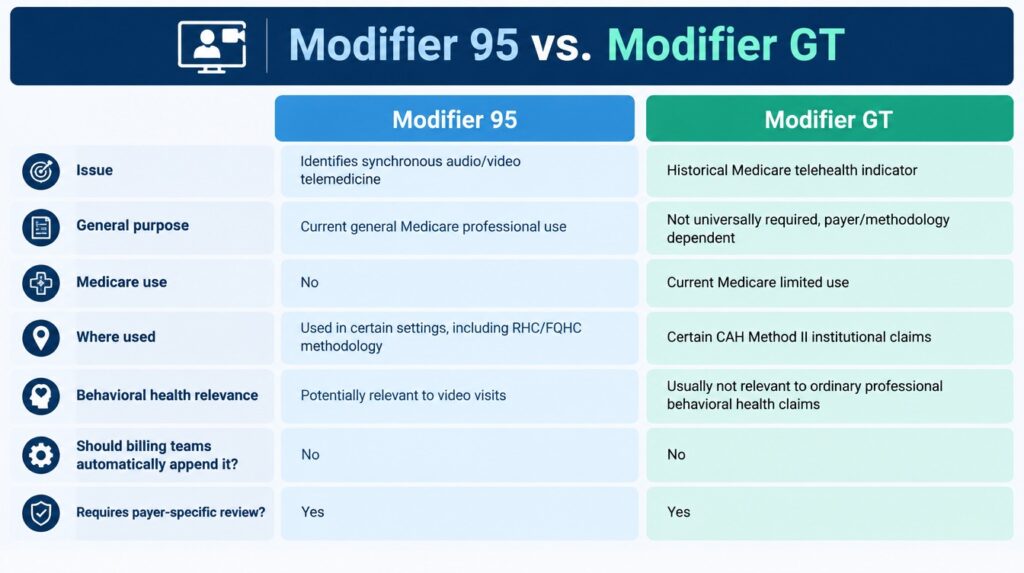
The important lesson is not that 95 is “the new GT.”
That phrase is too simplistic.
The two modifiers have different historical and current applications.
POS 10 means:
Telehealth Provided in Patient’s Home.
CMS defines this as a location where health services are provided or received through telecommunications technology while the patient is in their home. CMS specifies that the home is a private residence other than a hospital or other facility where the patient receives care.
For behavioral health, POS 10 is highly relevant because Medicare permanently removed geographic and originating-site restrictions for behavioral health telehealth services. CMS states that beneficiaries can receive behavioral health telehealth services in their homes in both rural and urban areas.
That means a Medicare beneficiary does not need to travel to a clinic merely because the service is behavioral health.
A psychiatrist conducts a psychiatric evaluation by secure video.
The patient participates from a private residence.
The provider is at the practice office.
The claim should identify the appropriate behavioral health service code and, for Medicare professional billing, report POS 10 because the patient was in the home.
Whether Modifier 95 is also reported depends on the applicable billing methodology and payer requirements.
The POS code answers the location question.
POS 02 means:
Telehealth Provided Other than in Patient’s Home.
CMS defines POS 02 as a location where health services are provided or received through telecommunications technology when the patient is not in their home.
Consider a patient who visits a community behavioral health facility but meets with a psychiatrist located at another site through secure video.
The patient is not in a private residence.
POS 02 can identify the telehealth location in this situation for Medicare professional billing.
Other examples may include a patient receiving a telehealth service from an eligible facility or other non-home setting, subject to payer policy.
The key differencebetween POS and POS 02 is:
The provider’s physical location does not determine whether the claim uses POS 10 or POS 02.
The patient’s location does.
This is an important point for behavioral health organizations with clinicians working remotely.
Suppose the clinician works from home while treating a patient who is also at home.
The clinician’s home does not make the claim POS 10.
POS 10 is based on the patient’s location.
Likewise, if a clinician works from an office while the patient is at home, the claim can still use POS 10.
POS is not merely descriptive.
It can affect Medicare payment.
CMS states that beginning January 1, 2024, Medicare pays telehealth services provided to patients in their homes at the non-facility Physician Fee Schedule rate.
That makes accurate POS reporting important for revenue-cycle management.
If a behavioral health practice routinely reports POS 02 for patients who were actually at home, the issue is not simply that the claim contains the wrong two-digit code. The incorrect POS can affect payment logic and trigger claim edits.
For this reason, the patient-location field in the EHR should be treated as a billing data element, not just a scheduling detail.
A useful way to structure the claim is:
Select the CPT or HCPCS code that accurately represents the behavioral health service performed.
Verify that the payer covers the service when delivered through the applicable telehealth modality.
If the patient was at home, consider POS 10.
If the patient was somewhere other than home, consider POS 02.
If the service was synchronous audio/video, determine whether the payer requires Modifier 95.
If the encounter was audio-only, do not automatically use 95. A different code or modifier may apply depending on the payer.
Medicare, Medicaid and commercial insurers may use different reporting requirements.
The record should support the service, medical necessity, participants, date, duration or other applicable coding requirements, and the telehealth modality when required.
This workflow is much safer than telling billers to attach 95 or GT to every virtual encounter.
Medicare’s behavioral health telehealth rules deserve separate attention because Congress and CMS have made behavioral health an important exception within the broader telehealth framework.
CMS states that geographic and place-of-service restrictions were permanently removed for behavioral health telehealth services. Beneficiaries can receive behavioral health telehealth services at home, including in rural and urban locations. CMS also permits two-way interactive audio-only technology for behavioral health telehealth services under applicable rules.
This is why an older statement such as “Medicare telehealth requires the patient to be in a rural originating site” is misleading when applied broadly to behavioral health in 2026.
The rule needs to be separated by service category.
Behavioral health is treated differently
CMS specifically states that the telehealth geographic and originating-site limitations do not apply to behavioral health services in the same way they apply to many other Medicare telehealth services.
That is particularly important for:
However, the service must still satisfy all other applicable Medicare coverage, coding, practitioner eligibility and documentation requirements.
Telehealth flexibility does not eliminate medical necessity requirements.
One of the most important changes for 2026 involves the statutory in-person requirements associated with Medicare mental health services furnished through telecommunications technology.
CMS’s published materials have reflected a requirement for an in-person mental health service within six months before telehealth mental health treatment and at least every 12 months thereafter, subject to an exception when the clinician and patient determine that the risks and burdens outweigh the benefits and the clinician documents the decision.
However, subsequent federal legislation in 2026 delayed implementation of the in-person requirements. The 2026 legislative language moved the effective date from January 31, 2026 to January 1, 2028. CMS’s 2027 proposed rule likewise describes the 2026 legislation as requiring the in-person visit requirements for mental health telehealth to remain inapplicable through December 31, 2027.
For a 2026 billing article, this distinction matters.
A billing guide should not simply repeat an older CMS manual paragraph and state that every Medicare behavioral health telehealth patient must complete an in-person visit during 2026.
Organizations should follow the current CMS implementation guidance and applicable legislation for the date of service.
This is one of the most common questions.
The answer is:
Sometimes, but not automatically for Medicare professional claims.
POS 10 identifies the patient’s home as the telehealth location.
Modifier 95 identifies synchronous audio/video telemedicine when the applicable payer or billing methodology requires that modifier.
A commercial payer might instruct a behavioral health provider to report:
CPT code + POS 10 + Modifier 95
for a video visit with a patient at home.
Another payer might instruct the provider to use:
CPT code + POS 10
without 95.
Medicare’s professional telehealth framework uses POS 10 and POS 02 to identify the location. CMS’s current telehealth materials also show that Modifier 95 remains relevant in specific billing arrangements, including RHC/FQHC telehealth reporting and other defined circumstances.
Therefore, the claim should follow the payer’s current instructions rather than a universal combination rule.
For ordinary Medicare professional behavioral health claims, this should not be treated as a standard combination.
GT was eliminated as a general professional Medicare telehealth requirement in 2018.
If a payer contract or state Medicaid program specifically requires GT, the provider should follow that payer’s policy.
But a behavioral health practice should not create an internal rule such as:
“All home telehealth visits use POS 10 + GT.”
That rule confuses an older Medicare reporting convention with current claim requirements.
Yes, when the payer’s policy calls for Modifier 95 and the encounter meets the definition of synchronous audio/video telehealth.
For example, a patient receives psychotherapy from a community facility while the behavioral health clinician participates from another location through real-time audio/video.
The patient is not at home, so POS 02 may apply.
If the payer requires Modifier 95 for the video encounter, the claim may report the service with POS 02 and Modifier 95.
But again, payer instructions control.
The important point is that POS 02 and Modifier 95 answer different questions.
POS 02 answers:
Where was the patient receiving telehealth?
Modifier 95 answers:
Was the service delivered synchronously through real-time audio/video technology?
Commercial payer policies often retain telehealth reporting conventions that do not exactly mirror Medicare.
A payer may require:
Some commercial plans also distinguish between audio/video and audio-only encounters.
That means a behavioral health organization’s payer matrix should never have a single line that says:
Telehealth = Modifier 95
Instead, the matrix should identify the requirement by payer and product.
A useful structure is:
| Payer | Patient home | Patient non-home | Video | Audio-only | Modifier | Notes |
| Medicare | POS 10 | POS 02 | Verify current telehealth eligibility | Separate rules | Payer-specific | Follow current CMS guidance |
| Medicaid | State/payer rule | State/payer rule | State/payer rule | State/payer rule | State/payer rule | Check state Medicaid and MCO |
| Commercial Plan A | Payer rule | Payer rule | Payer rule | Payer rule | Payer rule | Contract controls |
| Commercial Plan B | Payer rule | Payer rule | Payer rule | Payer rule | Payer rule | Verify current policy |
This approach is more useful than memorizing a single modifier.
Medicaid is especially important because there is no single nationwide Medicaid telehealth billing rule.
Federal Medicaid policy provides states with flexibility, and individual state Medicaid agencies determine many telehealth coverage and billing requirements within the applicable federal framework.
Managed care organizations can also publish plan-specific billing instructions.
Therefore, a behavioral health provider billing Medicaid should identify:
A modifier that is correct for a commercial payer in one state may not be correct for the state’s Medicaid program.
This is one reason national telehealth billing articles should avoid statements such as “Medicaid requires Modifier 95.”
Medicaid does not operate under one universal claim-level telehealth rule across all states and plans.
Telehealth can apply to a range of behavioral health services, but eligibility depends on the payer and service.
Common examples include:
Behavioral health practices frequently provide individual, family and group psychotherapy through synchronous video.
The provider must report the appropriate psychotherapy CPT code based on the service performed and applicable coding rules.
Telehealth reporting then communicates the remote delivery method and patient location.
Psychiatric diagnostic evaluations may be furnished through telehealth when the payer permits the service and the clinician meets the applicable requirements.
The claim should not use a generic “telehealth code” instead of the CPT code describing the actual professional service.
Psychiatrists and other eligible practitioners may provide certain E/M services through telehealth when the payer permits them.
The appropriate E/M code should be selected based on the service and the applicable coding guidelines.
Telehealth can also play an important role in behavioral health and substance use disorder treatment.
Medicare has specific telehealth rules for opioid treatment programs and certain SUD services. For example, CMS instructs OTPs to use POS 58 for OTP services, including services delivered through audio/video or audio-only technology, with Modifier 95 or 93 for specified counseling and therapy codes depending on the technology used.
This illustrates why providers should not assume that POS 10 or POS 02 applies to every behavioral health telehealth service.
The service setting and billing methodology can override the general professional telehealth pattern.
Correct modifiers and POS codes cannot rescue weak documentation.
The medical record should support the underlying service and, when applicable, the telehealth method.
A strong telehealth note generally establishes:
The exact documentation requirements vary by service and payer.
The note should support what the claim says.
If the claim reports POS 10 but the record consistently identifies the patient as being in a residential treatment facility, the organization has a data integrity problem.
If the claim reports video telehealth but the note documents a telephone-only encounter, the claim and record do not tell the same story.
One practical improvement is to capture the patient’s location during check-in.
The EHR can ask:
Where are you physically located today?
Possible responses can then map to the appropriate billing workflow.
For example:
The system should not infer the patient’s location from the provider’s address.
That is one of the most common sources of incorrect POS reporting.
They are not simply alternatives.
POS 10 describes the patient’s location.
Modifier 95 describes synchronous audio/video telemedicine.
A payer may require one, both or neither depending on the claim methodology.
Correction
Build the claim logic around separate questions:
Then apply the payer’s reporting rules.
This is one of the clearest outdated billing practices.
CMS eliminated the general requirement for GT on Medicare professional telehealth claims effective January 1, 2018.
Correction
Remove outdated GT instructions from Medicare professional behavioral health billing guides unless the organization has a specific claim type for which CMS still requires GT.
POS 02 is not the universal telehealth POS code.
CMS created POS 10 specifically for telehealth delivered to a patient in the patient’s home.
Correction
Ask where the patient was physically located at the time of the encounter.
Home generally points to POS 10.
Non-home telehealth generally points to POS 02 under the Medicare professional framework.
The POS code describes the patient’s location, not the provider’s location.
Correction
Capture patient location separately from provider location.
They do not necessarily.
A commercial plan may require Modifier 95 when Medicare does not require it on the same type of professional claim.
Correction
Maintain payer-specific billing rules.
Modifier 95 does not make a non-covered service payable.
Correction
First verify:
Then apply the telehealth reporting elements.
Modifier 95 describes synchronous audio/video. It should not automatically be used for an audio-only encounter.
CMS now uses Modifier 93 for certain synchronous audio-only telehealth claims, including the current RHC/FQHC methodology.
Commercial and Medicaid requirements can differ.
Correction
Create a separate audio-only workflow rather than treating it as a variation of video telehealth.
The best telehealth workflow is not a single modifier rule. It is a set of payer-specific claim rules.
A behavioral health organization should maintain at least these fields:
| Data element | Example |
| Payer | Medicare |
| Product | Original Medicare |
| Service | Psychotherapy |
| Modality | Audio/video |
| Patient location | Home |
| POS | 10 |
| Modifier | Based on current payer rule |
| CPT/HCPCS | Appropriate service code |
| Documentation | Telehealth note |
| Eligibility | Confirmed |
| Coverage | Confirmed |
For commercial plans, the same table can show whether Modifier 95 is required.
For Medicaid managed care, the matrix should identify the specific state and MCO.
This approach is far more reliable than asking individual billers to remember which modifier “usually” applies.
An effective claim scrubber can catch several preventable errors before submission.
Useful edits include:
If the payer requires a telehealth modifier in addition to POS 10, flag the claim before submission.
Flag GT for review rather than automatically deleting it. The purpose is to determine whether a special billing methodology applies.
If the encounter workflow identifies the patient as being at home but the claim contains POS 02, route it for review.
Flag a claim carrying 95 when the encounter record indicates telephone-only delivery.
Require the location field before releasing a telehealth claim.
If a commercial payer requires 95 but the Medicare rule set does not, the claim scrubber should apply the correct payer-specific configuration.
These edits turn telehealth coding from a memory exercise into a controlled revenue-cycle process.
The table should be used as a starting point, not as a substitute for the payer’s current billing manual.
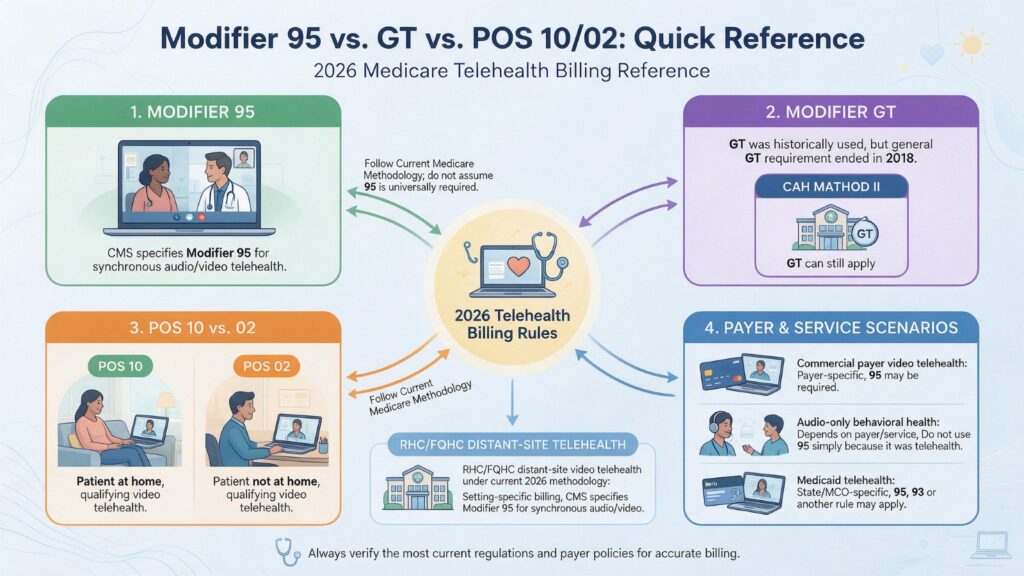
Modifier 95, Modifier GT, POS 10, and POS 02 are not four interchangeable ways of saying “telehealth.”
They represent different pieces of claim information.
For behavioral health billing in 2026, the safest workflow is to determine the service first, verify telehealth eligibility, identify the patient’s actual location, determine whether the encounter was video or audio-only, and then apply the payer’s reporting requirements.
For Medicare professional claims, POS 10 and POS 02 are central to the current telehealth location framework. Behavioral health also receives important telehealth flexibility, including the ability to furnish qualifying services to beneficiaries in their homes.
At the same time, commercial insurance, Medicaid programs and managed care organizations can use different combinations of POS codes and modifiers. A billing policy that works for one payer should not automatically become the rule for every other payer.
The most reliable telehealth claim is therefore not the one carrying the most codes. It is the one where the CPT or HCPCS code, patient location, telehealth modality, payer rules and documentation all describe the same encounter.
Insurance denials for mental health claims are not just frustrating. They have become a systemic problem.
Behavioral health services are denied at rates significantly higher than medical claims, with some estimates suggesting an 85% higher denial rate for substance use disorder claims compared to medical-surgical claims.
This disparity exists despite the Mental Health Parity and Addiction Equity Act (MHPAEA), which requires insurers to provide mental health coverage comparable to physical health coverage.
The majority of denials can be successfully overturned through a well-prepared appeal. The key is understanding the process, gathering strong supporting documentation, and knowing how to argue your case effectively.
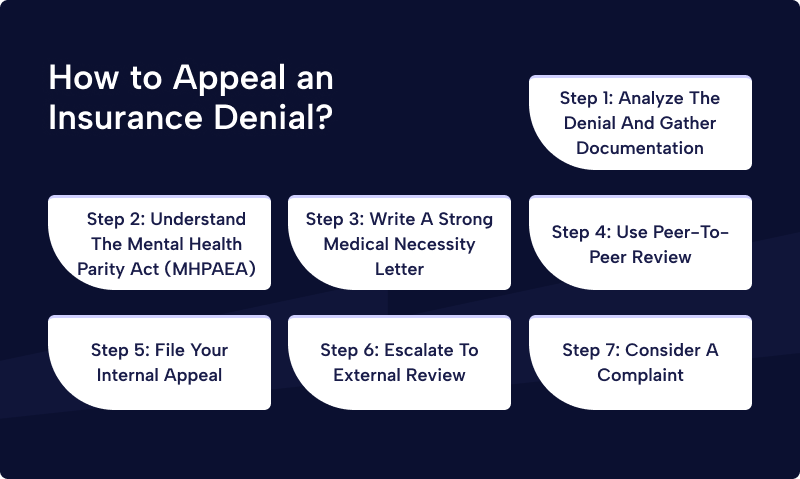
Before any action, you need to understand the payer’s specific reason for denial. This information is found on the Explanation of Benefits (EOB) or denial letter. The denial reason determines your appeal strategy. Common reasons for mental health claim denials include:
Gather Comprehensive Supporting Documents
A successful appeal hinges on providing clear, evidence-based documentation. At a minimum, you should have ready:
The Mental Health Parity and Addiction Equity Act (MHPAEA) is a federal law that requires insurance plans offering mental health and substance use disorder benefits to provide coverage at levels no more restrictive than medical/surgical benefits. The 2024 final rule strengthened enforcement significantly. Plans must now conduct and document comparative analyses of their NQTLs, demonstrating that factors and evidentiary standards used for MH/SUD benefits are comparable to those for medical/surgical benefits.
Common parity violations include:
These violations often persist because they involve Non-Quantitative Treatment Limitations (NQTLs) that are harder to identify and challenge than explicit day caps or copay differences.
What a Parity-Violation Denial Looks Like
Recognizing a parity violation is the first step to a successful appeal. The most common patterns in behavioral health denial queues include:
| What Payers Do When They Receive a Properly Framed Parity Appeal Data from experienced revenue cycle management shops shows that approximately 40% of properly framed parity appeals pay on first-level appeal when the appeal includes proper MHPAEA citation, an equivalent med-surg comparison, and a request for comparative analysis. About 25% deny first-level but pay on second-level. About 15% pay during external review. The total recovery rate on properly worked parity appeals is 75-85%. |
The medical necessity letter is often the most critical element of a successful appeal, especially when the denial is based on clinical grounds. A template from the mental health advocacy resource, Cover My Mental Health, and the American Psychiatric Association provides an excellent foundation for this letter.
Key Elements of an Effective Appeal Letter
1. Introduction. State clearly who you are, your relationship with the patient, the patient’s diagnosis, and a direct statement that you are appealing the denial. Include the patient’s date of birth and health plan ID.
2. Provider Credentials. Describe your qualifications and level of experience in treating patients with this specific diagnosis. This establishes your credibility and expertise.
3. Clinical History. Provide a detailed chronology of the patient’s mental health history, including prior treatments tried, medications, and any past hospitalizations. Describe the patient’s level of functioning and specific symptoms.
4. Rationale for Treatment. Explain why the requested treatment is medically necessary. Justify the level of care, frequency, and duration based on evidence-based standards. Cite clinical guidelines from organizations like APA, AACAP, or ASAM to support your argument.
5. Address the Denial and Plan Criteria. Go through the plan’s criteria and explain how the patient meets them. If the patient does not meet plan criteria, use community standards such as LOCUS, CASII, or ASAM criteria to demonstrate medical necessity. Different criteria exist for admission and continued stay, and for children/adolescents versus adults.
6. Procedural Violations. If there have been any, cite the state or federal code that the plan violated. Examples include failing to timely respond to claims, failing to provide access to an adequate network, or failing to provide the client with a plan manual.
7. Conclusion. Briefly summarize your argument and reiterate the request for coverage.
| A Real-World Example: A child and adolescent psychiatrist in Chicago treated a teenage girl with obsessive-compulsive disorder whose symptoms became severe. The insurance company initially denied daily therapy, allowing only once a week. Doctor gathered evidence about the efficacy of exposure therapy, wrote a letter to the insurance company, and was able to get the company to approve therapy three times a week. “This girl got better within six weeks, was able to go back to school, and eventually tapered the therapy to once a week,” Doctor said. |
Free Resources for Medical Necessity Letters
Cover My Mental Health is a nonprofit organization that provides free tools for challenging insurance denials, including a template for writing medical necessity letters. The site offers practical information and sample text for how to write an effective letter of medical necessity.
The Austen Riggs Center provides two sets of resources to support clinician and patient efforts to secure insurance coverage for medically necessary behavioral health treatment.
For many clinical denials, a peer-to-peer review can be incredibly effective. This is a call or review between the patient’s treating clinician and an insurance company physician. This direct conversation can clarify clinical nuance that may be lost in a written document.
Practical Advice. The insurance reviewer on a case may not be a specialist in child psychiatry or the specific condition being treated. The treating clinician can explain special considerations involved in treating a specific population or condition. This often leads to approval or a compromise.
Follow the Payer’s Process and Deadlines
The provider or patient should first follow the insurance company’s internal appeals process. Deadlines are strict, typically requiring an appeal within 30 to 180 days of the denial notice. Most plans give you about 180 days from the date of the denial notice to appeal internally, but experts say not to wait.
Understanding Success Rates
The Virginia Bureau of Insurance reported that health carriers upheld denied claims involving mental health benefits in 64% of closed internal appeals. However, this means 36% were overturned on appeal. Persistence pays off.
If the internal appeal is unsuccessful, you have the right to request an external review. This is an independent review of the case by a third-party organization not affiliated with the insurance company. The outcome of an external review is often binding on the insurer.
A Real-World Example. A North Carolina couple’s insurance denied coverage for intensive psychiatric care, even after the husband attempted suicide twice. The instructions for an external review were buried on page seven of one denial letter. After submitting the request, an independent doctor overturned the denial, forcing the insurer to cover treatment that had cost the family more than $70,000.
Filing for External Review
When you file a request for a federal external review, your plan usually has five days to consider your request. If the insurer agrees that your denial is eligible, it will provide directions on where to file the appeal. Under federal rules, third-party review companies typically have between 45 and 60 days to decide the outcome of an external review.
Expedited External Appeals. If the situation is urgent, you may ask for an expedited appeal. Federal requirements typically call for expedited external appeals to occur as quickly as your condition requires but not take longer than 72 hours.
Success Rates of External Reviews
A study of independent medical review (IMR) appeals in California found that 50% of initially denied claims for depression treatment were overturned. This suggests that managed care organizations inappropriately deny claims and delay treatment. The study also found that reviews mentioning the CALOCUS (Child and Adolescent Level of Care Utilization System) criteria were more likely to be overturned (OR=1.5). Using standardized tools like CALOCUS, LOCUS, or ASAM can significantly improve appeal outcomes.
Connecticut data shows that the health care advocate office has been able to resolve or overturn denials in the patient’s favor about 80% of the time.
Patients have the option to file a complaint with their state’s Office of the Insurance Commissioner, which can investigate the issue, require the insurer to correct any unlawful actions, and impose penalties when appropriate.
Texas. The Texas Department of Insurance offers a Help Line that can answer insurance questions and explain appeal options. External reviews are free to the patient.
Additional Strategies to Maximize Success
Use Standardized Criteria Tools
Standardized criteria tools like the Level of Care Utilization System (LOCUS), Child and Adolescent Level of Care Utilization System (CALOCUS), and American Society of Addiction Medicine (ASAM) criteria are effective in appeals.
A study found that CALOCUS mention was independently associated with appeal overturns in California. These tools provide a systematic, evidence-based framework for determining the appropriate level of care.
Request the Payer’s Medical Necessity Criteria
When the denial is based on medical necessity, request a copy of the medical necessity criteria and specific reasons for denial the insurer is using. These criteria are often proprietary but must be provided upon request. Once you have them, you can compare them to established community standards and show how the patient meets them.
Cite Clinical Guidelines
Cite evidence-based clinical guidelines from professional organizations in the appeal letter. The Cover My Mental Health website emphasizes that a medical necessity letter can draw on evidence-based guidelines developed by APA, AACAP, ASAM, and other professional societies. These guidelines carry significant weight because they represent generally accepted standards of care.
Get State Regulatory Help
Maintain a Records Retention Policy
Keep all denial letters, explanation of benefits, correspondence, and plan documents. Most people have a right to request their claim file under federal regulations. If you have misplaced anything, contact the insurer for additional copies.
The First Letter Is the Hardest
Writing a medical necessity letter takes time and is not billable time. Dr. Karen Pierce acknowledges this: “Physicians are busy; it takes time to write a letter, it’s not billable time, and people see it as extra work. The first letter is the most difficult to write, but once you learn how to do it and have the template, you can write it and revise it quickly as many times as needed”.
Appealing a mental health insurance denial is a systematic process.
Success depends on careful analysis, robust documentation, and a clear understanding of both the payer’s policies and the patient’s rights under parity laws.
The financial return is significant, with 75-85% recovery rates on properly worked parity appeals.
While it is a significant administrative burden, persistence pays off. By following these steps, providers can effectively fight for the coverage their patients are legally owed.
The first appointment with a behavioral health patient often involves much more than simply discussing symptoms. Providers evaluate the patient’s mental health history, assess medical conditions, review medications, determine risks, establish diagnoses, and develop an initial treatment plan. When medical services are part of this comprehensive psychiatric evaluation, CPT Code 90792 is often the appropriate code.
Because CPT 90792 combines a psychiatric diagnostic evaluation with medical services, insurance companies closely review claims submitted under this code. Providers must understand who can bill it, what qualifies as medical services, how documentation should support the evaluation, and what reimbursement to expect.
This guide explains everything you need to know about CPT Code 90792 for 2026, including billing rules, documentation requirements, reimbursement rates, telehealth guidance, modifiers, and common claim denials.
According to the Current Procedural Terminology (CPT®) code set, CPT Code 90792 describes:
Psychiatric diagnostic evaluation with medical services.
This service includes a comprehensive psychiatric assessment together with medical services that fall within the provider’s scope of practice.
Unlike ongoing psychotherapy codes such as 90832, 90834, or 90837, CPT 90792 is primarily an evaluation service performed during an initial assessment or when a patient’s condition requires a new comprehensive diagnostic evaluation.
The phrase “with medical services” often confuses.
Medical services generally include activities that require medical training and clinical decision-making, such as:
Psychotherapy alone does not qualify as medical services for CPT 90792.
Many behavioral health providers confuse these two codes.
The primary difference is whether medical services are included.
| CPT Code | Description | Medical Services |
| 90791 | Psychiatric diagnostic evaluation | No |
| 90792 | Psychiatric diagnostic evaluation with medical services | Yes |
In general, licensed professionals who cannot perform medical services report 90791, while qualified medical professionals performing medical services may report 90792, consistent with payer policy and scope of practice.
Eligibility depends on state law, professional licensure, scope of practice, and payer policy.
Providers who commonly report CPT 90792 include:
Psychologists, Licensed Clinical Social Workers (LCSWs), Licensed Professional Counselors (LPCs), Licensed Mental Health Counselors (LMHCs), and Licensed Marriage and Family Therapists (LMFTs) generally bill 90791, because they typically do not furnish the medical services described by CPT 90792. Payer policies and state scope-of-practice laws should always be verified.
Common situations include:
Providers should not report CPT 90792 for routine follow-up medication checks or standard psychotherapy visits.
Good documentation shows why the psychiatric evaluation was medically necessary. It also helps prevent claim denials and supports your records during an audit.
A complete psychiatric diagnostic evaluation should include the following:
Include the patient’s name, date of service, provider’s name and credentials, and the location where the service took place.
Explain why the patient came for a psychiatric evaluation.
Example: The patient reports ongoing anxiety, worsening depression, and difficulty managing daily work responsibilities for the past three months.
Document when the symptoms started, how long they have lasted, their severity and frequency, factors that make them worse or better, previous treatment, and how they affect the patient’s daily life and functioning.
Include relevant information about previous psychiatric diagnoses, hospitalizations, suicide attempts, therapy, psychiatric medications, and substance use.
Document medical conditions that may affect the patient’s mental health or treatment, such as diabetes, thyroid disorders, neurological conditions, chronic pain, or cardiovascular disease.
Record the patient’s current and previous psychiatric medications, how well the medications have worked, any side effects or adverse reactions, and the patient’s medication adherence.
The Mental Status Examination should describe the patient’s current mental and behavioral state. Document relevant findings related to appearance, behavior, speech, mood, affect, thought process, thought content, perception, cognition, insight, and judgment.
Document any clinically relevant risks, including suicide risk, homicide risk, self harm, risk of violence, and protective factors.
Document the psychiatric diagnoses supported by the evaluation. Use the appropriate ICD 10 CM codes based on your clinical findings.
The treatment plan may include the initial diagnosis, medication recommendations when appropriate, psychotherapy recommendations, follow up plans, and safety planning when clinically necessary.
The provider should complete the record with their signature and required credentials according to applicable payer and practice requirements.
CPT Code 90792 reimbursement depends on several factors, including the payer, your provider contract, your geographic location, and the place where you provide the service.
Unlike commercial insurance companies, Medicare publishes its payment rates annually through the Medicare Physician Fee Schedule (MPFS). Commercial insurers negotiate reimbursement individually with participating providers, so there is no universal payment amount for CPT 90792.
Understanding both Medicare reimbursement and commercial insurance payment trends can help you estimate revenue, evaluate payer contracts, and identify underpayments.
For Calendar Year (CY) 2026, the national average Medicare non-facility allowable amount for CPT Code 90792 is approximately $173.35, before geographic adjustments.
Actual reimbursement varies because Medicare applies Geographic Practice Cost Indices (GPCIs) to reflect regional differences in practice costs. As a result, providers in different locations may receive different payment amounts for the same service.
| CPT Code | Description | Approximate National Medicare Rate* |
| 90792 | Psychiatric diagnostic evaluation with medical services | $173.35 |
*National average before locality adjustments. Actual reimbursement varies by Medicare Administrative Contractor (MAC), geographic location, and applicable payment policies.
Commercial insurance companies such as Cigna, Aetna, UnitedHealthcare, Optum, and Blue Cross Blue Shield do not publish national reimbursement schedules for CPT 90792.
Instead, they determine payment based on:
Independent reimbursement analyses generally show that commercial insurers often reimburse more than Medicare for psychiatric diagnostic evaluations, although payment varies widely across contracts.
Estimated Commercial Benchmark
| Insurance Type | Estimated Reimbursement |
| Medicare | Approximately $173 |
| Commercial Insurance | Often higher than Medicare depending on the negotiated contract |
These figures represent general market benchmarks and should not be interpreted as guaranteed reimbursement.
Although exact reimbursement varies by contract, many behavioral health providers report reimbursement within the following approximate ranges.
| Insurance Company | Estimated CPT 90792 Reimbursement** |
| Cigna | Approximately $190 to $260 |
| Aetna | Approximately $185 to $255 |
| UnitedHealthcare | Approximately $190 to $260 |
| Optum Behavioral Health | Approximately $185 to $255 |
| Blue Cross Blue Shield | Varies by state and individual plan |
These estimates come from independent reimbursement analyses and publicly available pricing information. They are not official fee schedules published by the insurers. Actual reimbursement depends on your negotiated contract, geographic location, provider specialty, and the member’s health plan.

Even when two providers bill the same CPT code, reimbursement may differ significantly.
Several factors influence payment.
Only qualified medical professionals who perform psychiatric diagnostic evaluations with medical services may report CPT 90792.
Reimbursement may differ depending on whether the provider is a:
Insurance companies adjust reimbursement according to local healthcare markets.
Providers practicing in metropolitan areas often receive different reimbursement than providers in smaller communities because healthcare costs vary across regions.
In-network providers receive reimbursement according to their negotiated contract.
Out-of-network providers generally collect payment directly from the patient, and reimbursement depends on the patient’s out-of-network benefits and the plan’s allowed amount.
Even within the same insurance company, benefit plans differ.
The patient’s plan may affect:
Always verify benefits before the appointment.
Yes, when payer policy allows.
Medicare and many commercial insurers cover psychiatric diagnostic evaluations furnished through telehealth, provided all applicable coverage and billing requirements are met.
Before billing 90792 via telehealth, verify:
Coverage policies can change, so always review the current payer guidance before submitting the claim.
Sometimes.
A psychiatric diagnostic evaluation and psychotherapy may both occur on the same date if the services are medically necessary, separately identifiable, and fully documented.
However, payer policies differ.
Many insurers require providers to report the psychotherapy service separately using the appropriate psychotherapy CPT code when documentation supports both services.
Always review the payer’s same-day billing policy before submitting both services on one claim.
Generally, no.
According to CPT coding guidance, 90792 already includes medical services. Reporting a separate Evaluation and Management (E/M) service for the same encounter is generally not appropriate unless payer policy specifically permits separate reporting under distinct circumstances.
Always consult current CPT guidance and payer policies before reporting both services.
Many CPT 90792 claim denials happen because of simple billing or documentation errors. Providers can avoid many of these problems by reviewing each claim before submission.
CPT 90792 includes a psychiatric diagnostic evaluation with medical services. Do not use this code when the provider only performs a psychiatric evaluation without medical services. In that case, CPT 90791 may apply instead.
How to avoid it: Confirm that the provider performed and documented the medical services required to support CPT 90792.
Do not use 90792 for a routine medication management visit when the provider does not perform a new psychiatric diagnostic evaluation. Use the appropriate evaluation and management code or other applicable code based on the services provided and payer rules.
How to avoid it: Review the purpose and scope of the visit before selecting the CPT code.
Some providers may bill 90792 when they do not meet the requirements to provide the medical services included in the code.
How to avoid it: Verify the provider’s credentials, scope of practice, and payer requirements before billing 90792. If the provider does not qualify to provide the medical component, 90791 may be more appropriate when the service meets its requirements.
A claim may face problems when the medical services provided lack adequate supporting documentation.
How to avoid it: Clearly document relevant medical findings, medication review, prescribing decisions when applicable, and the clinical reasoning behind the treatment plan.
A vague or incomplete Mental Status Examination may not adequately support the psychiatric evaluation.
How to avoid it: Document relevant findings from the patient’s mental status examination based on the clinical assessment.
Claims may face rejection when the diagnosis information is missing or does not support the services provided.
How to avoid it: Report accurate ICD 10 CM diagnosis codes that reflect the conditions evaluated and treated during the visit.
Using the wrong provider credentials, NPI, or billing information can cause claim delays or denials.
How to avoid it: Review provider information before submitting the claim and make sure it matches the payer’s records.
When the provider reviews medications, makes prescribing decisions, or manages medication treatment, the documentation should support those services.
How to avoid it: Record relevant medication history, current medications, clinical response, side effects, adherence, and any medication decisions made during the evaluation.
Even an accurate claim can face denial if you submit it after the payer’s timely filing deadline.
How to avoid it: Submit claims promptly and track payer specific filing deadlines for each insurance plan.
CPT 90792 requires careful attention to provider eligibility, medical services, documentation, and payer rules. When you match the code to the actual service, support medical necessity, and submit clean claims on time, you can reduce avoidable denials and improve reimbursement.
CPT 90792 billing can become difficult when you manage payer rules, claim submission, eligibility checks, and denials alongside patient care. Mental Health Billing Services (MHBS)
helps behavioral health practices handle these billing tasks accurately, reduce claim errors, and improve revenue collection.
CPT Code 90792 reports a psychiatric diagnostic evaluation with medical services. It includes a comprehensive psychiatric assessment along with medical services such as medication evaluation, prescribing when appropriate, review of medical history, and treatment planning. It is commonly used during an initial psychiatric evaluation or when a patient requires a new comprehensive assessment.
Only providers who are legally authorized to furnish the required medical services and who meet payer credentialing requirements should report CPT 90792.
Depending on state law and payer policy, eligible providers may include:
Always verify payer-specific billing requirements because coverage policies may differ.
No.
Unlike psychotherapy codes such as 90832, 90834, and 90837, CPT 90792 is not a time-based code. The code represents a comprehensive psychiatric diagnostic evaluation with medical services rather than a service defined by a specific number of minutes.
Providers should spend enough time to complete the medically necessary evaluation and document all required components.
For Calendar Year 2026, the national average Medicare non-facility allowable amount for CPT 90792 is approximately $173.35 before geographic adjustments.
Actual reimbursement varies according to the provider’s locality and other Medicare payment policies.
Commercial reimbursement varies considerably because insurers negotiate payment individually with participating providers.
Your reimbursement depends on factors such as:
Commercial reimbursement is often higher than the Medicare allowable amount, but insurers do not publish a standard national reimbursement rate.
In most situations, no.
Because CPT 90792 requires medical services, psychologists generally report 90791 rather than 90792. However, state laws and payer policies can vary, and psychologists with expanded authority in jurisdictions that permit prescribing or other qualifying medical services should follow applicable regulations and payer guidance.
Among all psychotherapy CPT codes, 90837 is one of the most frequently billed by behavioral health providers.
It represents an individual psychotherapy session that lasts 60 minutes and is commonly used by psychologists, psychiatrists, licensed clinical social workers, professional counselors, marriage and family therapists, and other qualified behavioral health professionals.
Because CPT 90837 reimburses at a higher rate than shorter psychotherapy codes, it also receives greater scrutiny from Medicare and commercial insurance companies.
Providers should understand the code’s time requirements, documentation standards, medical necessity expectations, and payer-specific billing rules before submitting claims.
This guide explains everything you need to know about CPT Code 90837 for 2026, including who can bill it, reimbursement rates, documentation requirements, telehealth billing, common claim denials, and best practices to help you submit accurate claims and reduce reimbursement delays.
CPT Code 90837 describes:
Psychotherapy, 60 minutes with the patient.
This code reports an individual psychotherapy session that lasts 53 minutes or longer. It focuses on evaluating emotions, behaviors, thoughts, coping skills, interpersonal relationships, and mental health conditions through evidence-based therapeutic interventions.
Unlike psychiatric evaluation codes, CPT 90837 reports ongoing psychotherapy rather than diagnostic assessment or medication management.
Behavioral health providers commonly bill this code when delivering structured therapy for conditions such as:
Eligibility depends on state licensure, payer policy, and scope of practice.
Qualified providers commonly include:
Always verify payer credentialing requirements before billing.
Correct time reporting is one of the most important requirements for CPT 90837.
According to the CPT code set, 90837 is appropriate when psychotherapy lasts 53 minutes or longer.
General psychotherapy time thresholds include:
| CPT Code | Psychotherapy Time |
| 90832 | 16 to 37 minutes |
| 90834 | 38 to 52 minutes |
| 90837 | 53 minutes or longer |
Time should reflect the face-to-face psychotherapy service or the psychotherapy time allowed under applicable telehealth rules. It should not include unrelated administrative work completed before or after the session.
Accurate documentation of the session duration supports proper code selection and helps reduce audit risk.
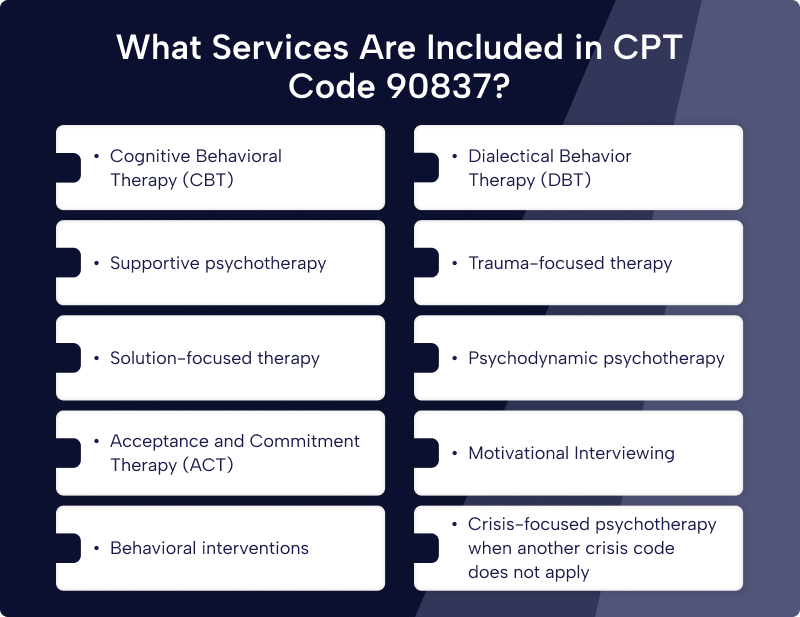
A 60-minute psychotherapy session may include a variety of therapeutic interventions based on the patient’s diagnosis and treatment goals.
Examples include:
The specific intervention should match the patient’s documented clinical needs and treatment plan.
Complete documentation is essential for demonstrating medical necessity and supporting reimbursement.
A well-documented psychotherapy note should generally include:
Document:
Record the actual psychotherapy time.
For example:
Psychotherapy provided from 2:00 PM to 2:58 PM (58 minutes).
Avoid vague entries such as:
“One-hour therapy session.”
Specific start and stop times or total documented psychotherapy time provide stronger support during claim reviews and audits.
Describe the patient’s current symptoms and clinical status.
Examples include:
Document findings that support the medical necessity of continued psychotherapy.
Therapeutic Interventions
Explain the interventions you used during the session.
Examples include:
Avoid generic statements such as:
“Provided therapy.”
Instead, clearly document what therapeutic techniques you used and why.
Describe how the patient responded to treatment.
Examples include:
Patient progress supports continued medical necessity.
Document:
Complete the note with your signature and credentials according to payer requirements.
One of the most common questions therapists ask is:
“How much does CPT Code 90837 reimburse?”
The answer depends on the insurance payer.
Medicare publishes its payment rates annually through the Medicare Physician Fee Schedule. Commercial insurers, including Cigna, Aetna, UnitedHealthcare, Optum, and Blue Cross Blue Shield, negotiate reimbursement rates individually with participating providers. As a result, there is no universal payment amount for CPT 90837.
Below is an overview of Medicare reimbursement and commercial insurance payment benchmarks for 2026.
For Calendar Year 2026, the national Medicare Physician Fee Schedule lists an average non-facility allowable amount of approximately $167.00 for CPT Code 90837 before geographic adjustments.
Keep in mind that Medicare payments vary because they incorporate Geographic Practice Cost Indices (GPCIs). A provider practicing in New York City, for example, may receive a different payment than a provider in rural Kansas, even when billing the same CPT code.
| CPT Code | Service | Approximate National Medicare Rate* |
| 90837 | Individual Psychotherapy, 60 minutes | $167.00 |
*National average before locality adjustments. Actual Medicare reimbursement varies by locality and other payment policies.
Unlike Medicare, commercial insurance companies negotiate reimbursement through individual provider contracts.
Several factors influence payment, including:
Because every contract differs, commercial reimbursement varies considerably.
Industry reimbursement analyses generally show that contracted commercial payments for CPT 90837 often exceed Medicare reimbursement, although the percentage varies by payer and market.
| Insurance Type | Estimated Reimbursement |
| Medicare | Approximately $167 |
| Commercial Insurance | Often higher than Medicare depending on the provider contract |
These figures are intended only as general market benchmarks. Your actual reimbursement depends on your negotiated agreement with the payer.
Many therapists compare reimbursement across major commercial insurers before joining provider networks.
Although insurers do not publish national fee schedules, independent reimbursement analyses suggest the following approximate market ranges for many contracted providers.
| Insurance Company | Estimated CPT 90837 Reimbursement** |
| Cigna | Approximately $185-$250 |
| Aetna | Approximately $180-$245 |
| UnitedHealthcare | Approximately $180-$250 |
| Optum Behavioral Health | Approximately $180-$245 |
| Blue Cross Blue Shield | Varies significantly by state and plan |
These figures represent estimated commercial reimbursement benchmarks derived from independent market analyses and publicly available transparency data. They are not official fee schedules or guaranteed payment amounts. Actual reimbursement depends on provider contracts, geographic location, specialty, and the patient’s benefit plan.
Even therapists working in the same city may receive different payments for CPT 90837.
Several factors influence reimbursement.
Insurance companies often negotiate different reimbursement rates for different provider types.
Examples include:
Some payer contracts reimburse doctoral-level providers differently from master’s-level clinicians.
Healthcare costs differ across the country.
Urban markets with higher operating expenses frequently have higher contracted reimbursement than rural markets.
Your participating provider agreement remains the single biggest factor affecting reimbursement.
Providers who renegotiate contracts periodically may receive higher reimbursement than providers with older agreements.
In-network providers receive reimbursement according to their negotiated contract.
Out-of-network reimbursement depends on the patient’s benefits and the plan’s allowable amount. Providers generally collect payment from the patient and may provide a superbill if the patient plans to seek reimbursement.
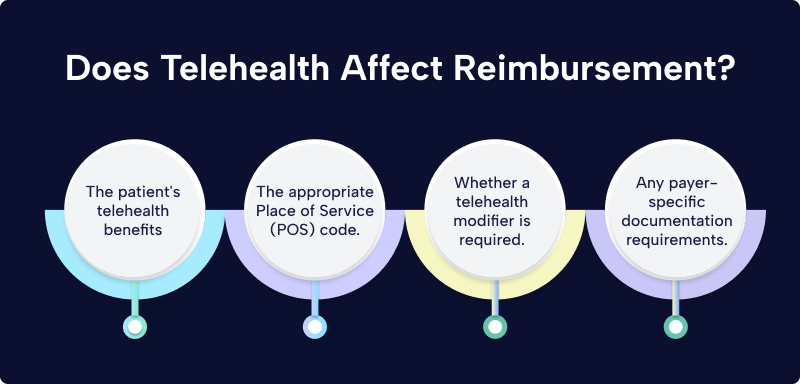
Many insurance companies continue to cover telehealth psychotherapy, but payment policies vary.
Before billing CPT 90837 through telehealth, verify:
Following current payer guidance helps reduce claim denials.
Because CPT 90837 represents the longest routine psychotherapy session, insurers often review these claims carefully.
Common denial reasons include:
Reviewing documentation before claim submission can improve first-pass payment rates.
To improve reimbursement and reduce denials:
Accurate coding, thorough documentation, and proactive verification can significantly improve reimbursement while helping your practice remain compliant with payer requirements.
CPT Code 90837 can support strong reimbursement when providers meet the required time, documentation, coding, and payer guidelines. Accurate session records, clear medical necessity, eligibility checks, and timely claim submission can help reduce denials and payment delays. Since reimbursement varies by payer and contract, always verify current requirements and rates before billing.
Managing psychotherapy billing, payer rules, documentation, and denials can take valuable time away from patient care. Mental Health Billing Service (MHBS) helps behavioral health providers manage the billing process, improve claim accuracy, reduce denials, and protect revenue.
Need help with your mental health billing?
Contact MHBS today to improve your billing process and maximize the reimbursement.
CPT Code 90837 reports individual psychotherapy lasting 60 minutes, with a documented psychotherapy time of 53 minutes or longer. Qualified behavioral health professionals use this code to bill ongoing one-on-one psychotherapy sessions for the diagnosis and treatment of mental health conditions.
For 2026, the national average Medicare non-facility allowable amount for CPT 90837 is approximately $167.00 before geographic adjustments.
Actual Medicare reimbursement varies because CMS adjusts payments using Geographic Practice Cost Indices (GPCIs). Your locality and Medicare Administrative Contractor (MAC) determine your final payment amount.
Commercial insurance reimbursement varies by payer and provider contract.
Many contracted commercial plans reimburse more than Medicare, but there is no standard national rate. Your reimbursement depends on factors such as:
Always refer to your contracted fee schedule or Explanation of Payment (EOP) for your actual reimbursement amount.
Yes.
Medicare and many commercial insurers cover CPT 90837 when the psychotherapy session meets telehealth billing requirements. Report the appropriate Place of Service (POS) code and any required telehealth modifier according to the payer’s billing guidelines. Always verify payer-specific requirements because modifier and POS rules can vary.
Which modifiers are commonly used with CPT 90837?
The required modifier depends on the payer and the circumstances of the service.
Common modifiers include:
Do not append modifiers unless payer policy supports their use.
Yes, in certain situations.
When the same provider performs both a psychiatric diagnostic evaluation with medical services (90792) and a medically necessary psychotherapy service on the same date, some payers allow both services if documentation clearly supports each service as separate and distinct. However, many payers have edits or additional documentation requirements.
Always verify the payer’s billing policy before submitting both codes on the same claim.
Underpayments are among the most overlooked revenue issues in behavioral health billing. They do not scream for attention as denials do. They sit quietly in the system. Most practices see a paid claim and move on. That is where the money slips away.
Behavioral health claims are especially vulnerable to underpayments. Therapy services are time-based. Psychiatry codes have strict documentation rules. Add-on codes get missed often. Payers know this. They rely on practices that do not check deeply. That is the harsh truth.
Underpaid behavioral health insurance claims are more common than most providers realize, and many mental health billing services overlook them entirely.
When underpayments go unappealed, revenue slowly bleeds out. Month after month. Year after year. Practices then blame low reimbursement rates, while the real issue stays hidden.
Appealing underpayments is not aggressive billing. It is compliant billing. You are simply asking to be paid what the contract already allows.
Underpayments happen in behavioral health more often than most practices realize. The work is complex. The rules are strict. Payers rely heavily on automated systems. Small gaps lead to reduced payment. The claim still shows as paid. That is why the issue stays hidden.
Ignoring underpaid claims creates a slow and steady drain on mental health practices. The damage does not show up overnight. It builds quietly over time. Most providers focus on denials and no-pay claims. Underpayments slip through because the claim shows as paid. That small assumption costs real money.
Appeal rights depend entirely on timelines. Each payer sets its own deadline. Missing it ends the conversation immediately.
Commercial payers usually allow between 90 and 180 days from the payment date. Medicare has structured appeal levels with strict timelines. Medicaid timelines vary by state and managed care organization.
Practices should never wait for month-end or quarter-end reviews. The underpayment review should occur within weeks of the payment posting. Early action preserves appeal rights.
Many recoverable underpayments are lost simply because they are discovered too late.
Under Medicare, underpayment disputes follow a structured multi-level appeal process, beginning with redetermination and progressing through reconsideration and administrative law judge review if necessary.
Commercial payers often follow internal reconsideration and formal appeal stages. Understanding these levels strengthens recovery efforts and protects appeal rights.
Certain behavioral health CPT codes are more vulnerable to underpayments:
Time-based downgrades and add-on misprocessing frequently impact these services.
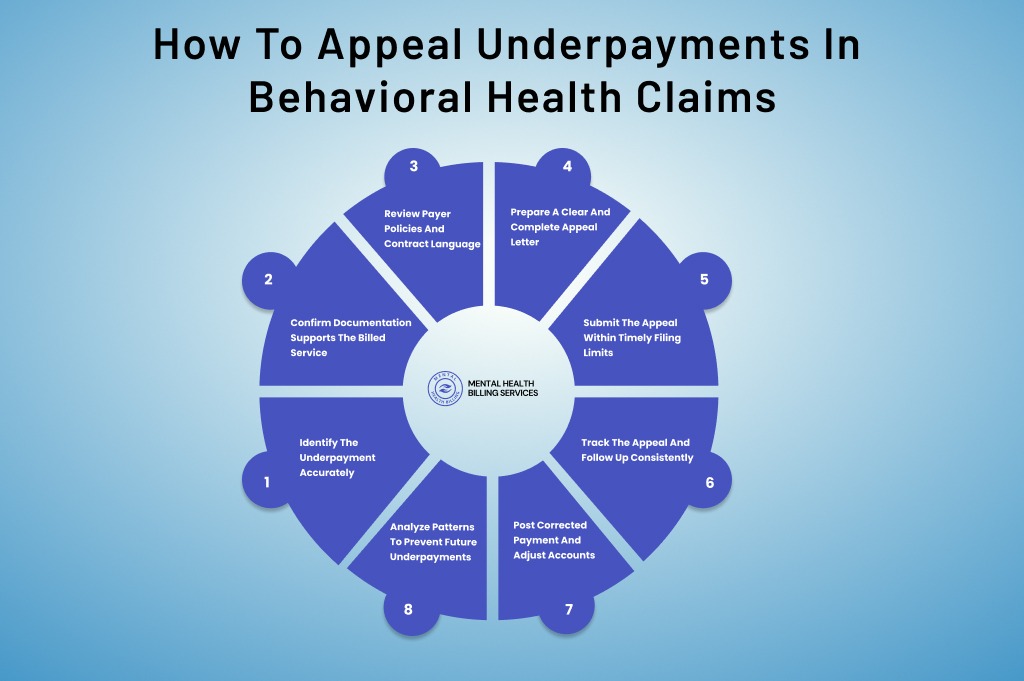
Appealing underpayments in behavioral health requires structure, timing, and persistence. The process is not complicated, but it demands consistency. When followed correctly, it recovers revenue that was already earned. Many practices fail here because they rush or skip steps. A step-by-step approach keeps the process clean and compliant.
The process starts with detection. A claim must be reviewed after payment posts. Do not assume paid means correct. Compare the paid amount on the EOB or ERA to the contracted allowed amount. This step requires access to payer contracts and current fee schedules. Behavioral health claims are especially vulnerable to time-based downgrades and stripped add-on codes. Look closely at therapy duration, crisis services, and telehealth claims. If the allowed amount does not match the contract, the claim qualifies for appeal.
Before appealing, confirm the clinical record fully supports the code billed. Time must be clearly documented for therapy and crisis services. Medical necessity must be evident. Provider credentials must align with payer requirements. If the documentation is weak, the appeal will fail. Appeals should proceed only when the service is defensible. Clean documentation strengthens your position and speeds resolution.
Each appeal must be grounded in payer rules. Review the payer’s behavioral health policy, billing manual, and fee schedule. Identify where the payer processed the claim incorrectly. This may involve misapplying time thresholds, ignoring modifiers, or using an outdated rate. Referencing payer policy language increases approval rates. It shows that the appeal is not opinion-based. It is rule-based.
The appeal letter should be direct and factual. Include the claim number, date of service, CPT codes billed, and amount paid. Clearly state the expected allowed amount based on the contract or policy. Explain the discrepancy in simple language. Attach supporting documents, including the EOB, session notes, and relevant contract pages. Avoid emotional language. Professional clarity wins appeals.
Timelines matter. Commercial payers often allow 90 to 180 days from the payment date. Medicare and Medicaid have structured deadlines. Submit the appeal as soon as the underpayment is identified. Late submissions are denied automatically. Track submission dates carefully to protect appeal rights.
Submitting the appeal is not the end. Follow-up drives results. Log each appeal with a reference number and expected response date. Follow up every 30 days if no response is received. Many underpayment appeals require multiple touches before resolution. Persistence increases recovery rates significantly.
Once the payer reprocesses the claim, review the corrected EOB. Confirm the allowed amount matches the contract. Post adjustments accurately. If payment is still incorrect, escalate to the next appeal level if available. Do not close the account until it balances correctly.
Every appeal provides insight. Track which codes, payers, and scenarios underpay most often. Use this data to improve coding, documentation, and payer communication. Prevention reduces future workload and protects revenue.
Recovering underpayments matters. Preventing them protects long-term revenue.
Behavioral health underpayments often follow predictable patterns. The same CPT codes get downgraded. The same modifiers are misprocessed. Telehealth logic is applied inconsistently. Identifying these trends early prevents recurring revenue loss.
Proactive contract monitoring is the foundation. Maintain updated payer fee schedules and compare allowed amounts regularly. Behavioral health reimbursement rates change more often than most practices realize. Without routine verification, outdated rates can silently reduce collections.
Front-end accuracy is equally critical. Eligibility verification should confirm not just coverage, but reimbursement structure and provider tiering. Many underpayments stem from credential-level rate mismatches that go unnoticed for months.
Clear, standardized documentation reduces time-based downgrades. Therapy notes must reflect total session minutes, medical necessity, and correct linkage of crisis or add-on codes. Consistency strengthens both initial claims and future appeals.
Regular modifier and telehealth audits also prevent repeat errors. Small configuration issues in billing systems can affect hundreds of claims before detection.
Preventing underpayments is not about constant appeals. It is about building structured behavioral health revenue cycle oversight that identifies discrepancies early and corrects them before revenue is lost.
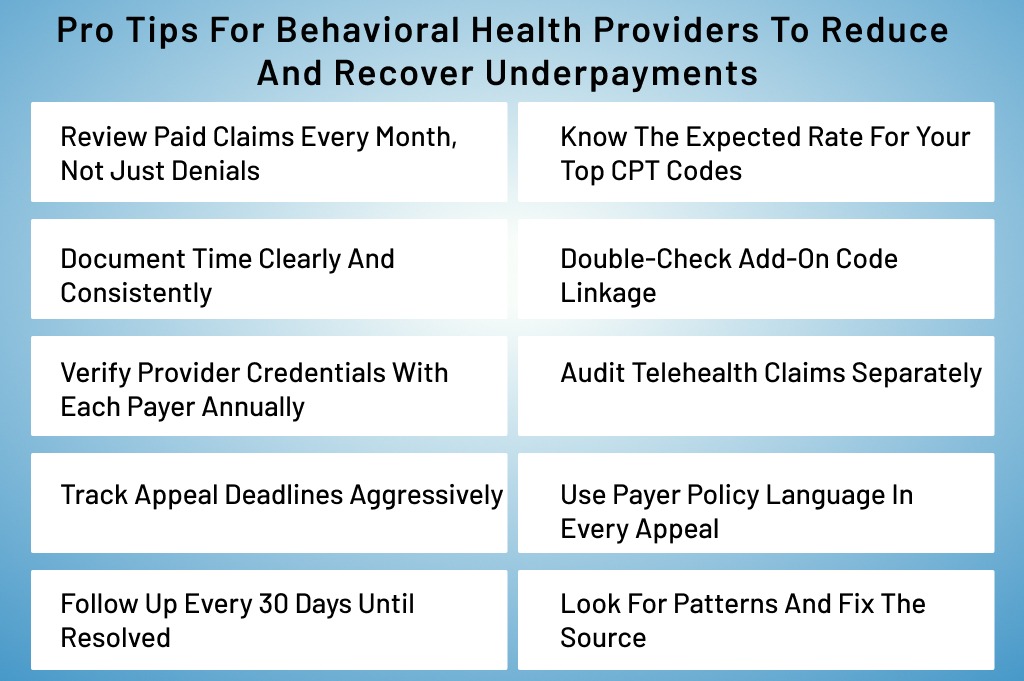
Behavioral health providers can protect revenue by becoming more involved in the billing process, even if billing is outsourced. You do not need to manage claims daily, but you should understand how your services are reimbursed. Knowing your common CPT codes and expected reimbursement ranges helps you recognize when something feels off. Awareness is the first layer of defense.
Underpayments are one of the most costly and overlooked problems in behavioral health billing. They do not announce themselves. They quietly reduce revenue while practices stay busy and providers work harder.
Appealing underpayments is not about chasing money. It is about claiming what was already earned. When done correctly, the process is compliant, professional, and effective.
Behavioral health practices that ignore underpayments struggle with cash flow, distorted financial data, and limited growth. Practices that address them operate with clarity and confidence.
By understanding why underpayments happen, identifying them early, and following a structured appeal process, providers protect their revenue without increasing patient volume.
Choosing the right insurance panels can shape the entire future of a therapy practice.
The insurance participation is no longer just about getting paid. It affects how easily clients can find you, how consistent your schedule is, and how much administrative pressure your practice faces each month.
Therapists today operate in a payer-driven environment where coverage rules, credentialing timelines, and reimbursement structures differ widely by insurer and by state.
A well-chosen panel mix can create predictable revenue and consistent referrals, while the wrong combination can slow cash flow and increase burnout.
This guide breaks down the 7 best insurance panels for therapists, helping you make informed decisions based on billing, credentialing, and compliance needs.
Not all insurance panels serve therapy practices the same way. Some bring high patient volume but demand heavy administrative effort, while others offer smoother workflows with fewer surprises at the billing stage. For therapists, the best insurance panels align with clinical focus, client demographics, and long-term revenue goals. Successful practices approach panel selection as a strategic decision rather than a checklist item. Understanding how each insurer handles credentialing, reimbursement, and utilization management allows therapists to build a balanced panel mix that supports consistent referrals, compliant billing, and sustainable growth without overwhelming daily operations.
Blue Cross Blue Shield is often considered the cornerstone insurance panel for therapy practices across the United States. With its presence in every state and a massive member base, BCBS plays a critical role in patient access to mental health services. Many clients actively seek therapists who accept BCBS because it is commonly offered through employer-sponsored plans and government programs. For therapists, joining BCBS can mean consistent appointment requests and long-term stability, but it also comes with payer-specific rules that require careful credentialing and documentation awareness.
Key Features & Benefits

Reimbursement Trends
Reimbursement varies by region and local plan, but BCBS is often regarded as one of the more competitive panels for therapy services. While exact contract rates are private, therapist surveys show average reimbursements for sessions usually trend toward the higher end of the commercial spectrum—especially for familiar CPT codes like 90834 (45 minutes) and 90837 (60 minutes).
Credentialing Process
Credentialing with BCBS for therapists requires patience and precision.
Credentialing with BCBS typically involves:
Turnaround time can range from several weeks to a few months, depending on the regional carrier.
BCBS panels often offer high exposure and a broad referral base, making them a strategic priority for practices seeking insurance-based growth.
Aetna has built a strong reputation among therapists for balancing reasonable reimbursement with structured administrative processes. As a national payer with a large employer-based population, Aetna often attracts working professionals seeking therapy services with predictable coverage. For private practices, Aetna can be a reliable source of recurring patients, especially in urban and suburban markets. However, success with Aetna depends heavily on understanding its credentialing workflow, authorization expectations, and claims submission standards.
Key Features & Benefits

Reimbursement
Therapists report average reimbursements that often compete strongly against other major carriers—typically in the $130+ range for standard therapy sessions (90837), though this varies by region and provider license.
Credentialing Process
Credentialing with Aetna is structured and detail-oriented.
To be credentialed:
Credentialing generally takes 4–8 weeks, depending on completeness and the responsiveness of follow-up.
Cigna is widely viewed as one of the more provider-friendly insurance panels in the behavioral health space. Therapists often describe Cigna as easier to work with compared to other large commercial payers, particularly during credentialing and claims processing. Its strong employer-based enrollment makes it a valuable panel for practices serving professionals and families. While reimbursement varies by region, Cigna remains a practical choice for therapists seeking smoother onboarding and fewer operational roadblocks.
Key Features & Benefits
Reimbursement
Industry surveys have shown that Cigna offers competitive reimbursement, with mean reimbursement rates often exceeding $100 per session.
Getting Credentialed
Credentialing with Cigna is typically straightforward for therapists.
Cigna expects documentation that clearly links the diagnosis to the treatment. Progress notes should reflect active clinical engagement rather than repetitive session summaries. Therapists who demonstrate treatment progression tend to avoid utilization reviews and payment interruptions.
Therapists need:
Typically 30–60 days for credentialing — sometimes faster with complete documentation.
UnitedHealthcare is one of the largest health insurers in the country, and its behavioral health network reaches millions of members nationwide. For therapy practices, UHC can significantly expand patient reach, especially in markets dominated by large employer groups. That said, UHC operates with detailed policies, strict utilization management, and evolving behavioral health guidelines. Therapists who succeed with UHC typically do so by aligning documentation, authorization, and coding practices closely with payer expectations.
Key Features & Benefits
Reimbursement & Coverage
Reimbursement is usually competitive, though survey data varies by region. According to some therapist surveys, UHC acceptance rates are substantial, with solid average therapy payments.
Credentialing Process:
Credentialing with UHC requires attention to detail.
What’s Needed to Join
Credentialing time can vary from 45 to 90 days.
Medicaid is a government health insurance program that covers low-income individuals and families. For many states, Medicaid’s behavioral health coverage includes therapy services as long as they meet medical necessity standards. Medicaid serves as a vital access point for mental health services, particularly for underserved and low-income populations.
Unlike commercial payers, Medicaid is administered at the state level, which means coverage rules, reimbursement rates, and credentialing requirements vary widely. For therapists committed to community-based care, Medicaid can provide consistent patient volume. However, it also demands strict adherence to state-specific policies, prior authorization rules, and documentation standards.
Key Features
Reimbursement
Medicaid reimbursement is typically lower than commercial panels, and rates vary widely by state. For example, Medicaid may pay significantly less than Medicare or BCBS for the same CPT code.
Credentialing Process
Credentialing is entirely state-driven.
Medicaid requires precise documentation, timely authorizations, and accurate coding. Therapists who build Medicaid-specific workflows reduce denials and payment delays.
Joining Medicaid
Medicare is playing an increasingly important role in therapy practices as the U.S. population continues to age. While Medicare reimbursement is often lower than commercial plans, it offers predictable payments and clearly defined coverage rules through federal fee schedules. For therapists working with older adults or patients with qualifying disabilities, Medicare can be a steady and dependable payer. Participation requires careful enrollment, compliance with federal documentation standards, and ongoing attention to coverage limitations.
Medicare covers therapy services for adults 65+, those with specific disabilities, and some younger adults with qualifying conditions.
Key Features
Reimbursement Snapshot
Medicare rates are publicly published in the Physician Fee Schedule and are typically lower than commercial panels but more stable. For example, 90834 and 90837 have defined national rates each year.
Credentialing Process:
Credentialing eligibility differs by therapist type.
Therapists who work with Medicare must be comfortable with detailed documentation and compliance-focused workflows.
How to Join
Specialized behavioral health organizations such as Magellan and Beacon Health Options function differently from traditional insurance companies. These entities manage mental health benefits on behalf of employers, government programs, and larger insurers. For therapists, these panels can open doors to complex cases, managed care referrals, and integrated behavioral health programs. While reimbursement structures are often standardized, success with these panels depends on understanding referral pathways, clinical reporting requirements, and network expectations.
Key Features
These organizations act as intermediaries or managed behavioral health organizations (MBHOs) that administer mental health benefits for larger payers.
Benefits
Credentialing
Typically similar to other carriers but may require additional documentation of specialties, hours, and clinical scope.
Credentialing often includes verification of:
These panels work best for therapists who are comfortable with structured care models and clinical reporting expectations.
Insurance Panel Comparison Table
| Insurance Panel | Coverage Reach | Typical Reimbursement¹ | Credentialing Time | Best For |
| Blue Cross Blue Shield (BCBS) | Nationwide | High | 6–12+ weeks | Broad referrals & high visibility |
| Aetna | National | Moderate–High | 4–8 weeks | Competitive pay + provider support |
| Cigna | National | Moderate–High | 30–60 days | Smooth onboarding |
| UnitedHealthcare (UHC) | National | Competitive | 45–90 days | Large member pool |
| Medicaid | State-based | Lower | 2–4+ months | Serving underserved populations |
| Medicare | Federal | Moderate | 60–90 days | Reliable payment source |
| Magellan / Beacon | Behavioral focus | Moderate | 6–12 weeks | Specialty mental health cohorts |
Reimbursement varies widely by state, license type, and contract specifics; it is generally determined based on average survey responses from therapists and credentialing guides.
Choosing the right panels is as strategic as choosing your therapy niche. Here’s how to evaluate them:
Look at the demographics you serve: families, seniors, employer-sponsored adults, Medicaid populations, etc. Joining panels that cover your ideal clients increases utilization.
Some panels pay well but require frequent pre-authorizations or complex billing. Others pay less, but process claims smoothly. Run the numbers. Estimate revenue minus administrative cost.
CAQH completion is essential. Panels with simpler processes and fewer documentation barriers help you credential faster.
Always review contracts carefully. Look for:
Negotiation may be possible, especially for high-demand specialties.
Reimbursement and demand vary dramatically by region. Talk to local peers or use benchmarking surveys to understand payer trends in your area.
Joining insurance panels is one of the most impactful decisions a therapy practice makes. Panels affect your client access, revenue predictability, administrative workload, and long-term practice growth.
The major carriers—BCBS, Aetna, Cigna, and UHC—provide broad coverage and generally reliable reimbursement. At the same time, government programs expand access to underserved populations, and specialized panels such as Magellan and Beacon offer targeted behavioral health referrals.
Your best panel mix depends on who your clients are, what services you provide, and how much administrative complexity you can manage.
Insurance credentialing is not easy—but when done right, it transforms a private practice from unpredictable to sustainable and scalable.
Insurance participation increases visibility but does not automatically fill a schedule. Client volume depends on network demand in your region, your specialty, availability, and how well your profile is optimized in insurer directories. Therapists in high-demand specialties such as trauma, child therapy, or substance use treatment often see faster referrals. Practices that combine insurance participation with local outreach and referral relationships achieve better results. Insurance panels create access, but marketing and positioning still matter.
Regional cost-of-living data, local provider supply, and negotiated contracts influence reimbursement. Insurers adjust rates based on market conditions, which explains why the same CPT code can pay very differently across state lines. License type also affects payment, especially when comparing psychologists, LCSWs, and clinicians. Government programs follow state or federal fee schedules, while commercial payers rely on internal pricing models. Understanding local benchmarks helps therapists evaluate whether a panel fits their financial goals.
Government programs generally reimburse less than commercial insurance, but they offer predictable demand and consistent payment rules. Practices that serve seniors, individuals with disabilities, or underserved communities often rely on these panels for steady referrals. Success depends on strong documentation, timely authorizations, and accurate coding aligned with coverage policies. Therapists who build workflows specific to government billing often reduce denials and payment delays. These panels work best when paired with efficient administrative processes.
Negotiation opportunities vary by payer and market conditions. Many insurers start with standard fee schedules, especially for new providers. Exceptions may exist for shortage areas, specialized services, or high-demand credentials. Negotiations typically occur before contract execution and require supporting data. Therapists who understand regional benchmarks and utilization trends are better positioned to discuss them. Even small rate increases can significantly impact long-term revenue.
Early credentialing helps stabilize income and reduces the pressure of relying solely on self-pay clients. New therapists benefit from joining panels aligned with their target population and local demand. Starting with one or two major carriers allows practices to learn payer workflows without becoming overwhelmed. Waiting too long can delay growth and limit referral opportunities. Strategic panel selection from the beginning creates a smoother path to sustainable practice development.
Mental health crises never follow a schedule. They show up unexpectedly, escalate fast, and demand immediate clinical attention. From a billing perspective, crisis psychotherapy is just as urgent and just as complex. CPT codes 90839 and 90840 were created to recognize this intensity. Yet these codes remain among the most misunderstood and misbilled in behavioral health.
I have seen many practices provide genuine crisis-level care but still get denied. The reason is simple. Crisis psychotherapy billing is strict. Time thresholds matter. Documentation language matters. Medical necessity matters. And payer rules vary more than most providers expect.
This guide breaks down everything you need to know about billing CPT 90839 and 90840 correctly. I will walk you through definitions, time rules, documentation, reimbursement, payer policies, denial risks, and real-world billing tips. The goal is simple. Help you get paid for the care you already provide.
Crisis psychotherapy is not just an extended therapy session. It is a distinct service designed for patients facing an immediate mental health emergency. These are moments where the patient is at high risk of harm to themselves or others, or when their psychological state has suddenly deteriorated to a dangerous level.
Think about a patient presenting with active suicidal ideation, a recent attempt, severe panic with dissociation, acute psychosis, or extreme emotional distress following trauma. In these situations, the provider is not working on long-term treatment goals. The focus is on safety, stabilization, and rapid intervention.
From a coding standpoint, crisis psychotherapy requires urgent assessment, intense therapeutic engagement, and active safety planning. Routine therapy codes do not capture this level of work. That is why CPT 90839 and 90840 exist.
CPT 90839 represents the first 60 minutes of crisis psychotherapy provided to a patient.
This code applies when the provider delivers face-to-face psychotherapy to stabilize an acute mental health crisis. The service must involve high-intensity therapeutic intervention, not just evaluation or routine counseling.
Time is critical here. CPT 90839 covers 30 to 74 minutes of total crisis psychotherapy time on the same date of service. If the session lasts less than 30 minutes, this code cannot be billed.
The provider must be actively engaged in crisis intervention throughout the time. Passive monitoring or non-therapeutic activity does not count.
CPT 90840 is an add-on code used when crisis psychotherapy extends beyond the first hour.
Each unit of 90840 represents an additional 30 minutes of crisis psychotherapy beyond the initial 60 minutes. This code is always billed in conjunction with 90839 and never on its own.
There is no explicit maximum number of 90840 units in the CPT manual. However, payers often apply medical necessity and reasonableness limits. Prolonged crisis sessions must be clearly justified in documentation.
Before jumping into the billing steps, it is essential to understand how these two codes work together but represent different parts of the same service.
CPT 90839 covers the initial crisis psychotherapy service, while CPT 90840 covers additional time beyond the first hour. One cannot exist without the other. 90839 is the foundation. 90840 builds on it.
Most billing errors happen when practices treat these codes like standard therapy add-ons. They are not. Crisis psychotherapy has its own rules, time thresholds, and documentation expectations.
Time-based billing is one of the most common denial triggers for crisis psychotherapy. You must meet the minimum time requirements exactly.
For CPT 90839, the total face-to-face time must fall between 30 and 74 minutes. Once the session reaches 75 minutes, you may bill 90839 plus one unit of 90840.
Here is how time typically breaks down in practice:
A 45-minute crisis session qualifies for 90839.
A 70-minute crisis session still qualifies only for 90839.
A 90-minute crisis session qualifies for 90839 plus one unit of 90840.
A 120-minute crisis session qualifies for 90839 plus two units of 90840.
Always document start and end times, not just total minutes. Many payers require clear time tracking for crisis codes.
Not every distressed patient qualifies for crisis psychotherapy. Payers look closely at whether the situation meets the definition of a true crisis.
A qualifying crisis typically includes imminent risk, such as suicidal or homicidal ideation, severe self-harm behavior, acute psychosis, or inability to maintain safety without immediate intervention.
Emotional distress alone is not enough. Anxiety, depression, grief, or relationship conflict may feel urgent, but they do not automatically qualify unless they escalate to a safety-threatening level.
Your documentation must clearly explain why the situation required immediate crisis intervention rather than a scheduled therapy session.
Crisis psychotherapy may be billed by qualified mental health professionals acting within their scope of practice. This commonly includes psychiatrists, clinical psychologists, licensed clinical social workers, licensed professional counselors, and other credentialed behavioral health providers.
Credentialing matters. If the provider is not credentialed with the payer for psychotherapy services, claims will be denied regardless of the quality of documentation.
Supervision rules also apply. Services provided by interns or trainees must follow payer-specific supervision and billing guidelines.
Documentation is the backbone of successful crisis billing. Even a single missing element can trigger a denial or an audit.
Your clinical note must clearly establish that a crisis existed. Start by describing the presenting problem in urgent terms. Explain what made the situation unsafe or unstable at that moment.
Next, document the interventions used. Crisis psychotherapy involves active therapeutic techniques such as de-escalation, safety planning, risk assessment, coping strategy development, and coordination of emergency resources when needed.
Time documentation must be precise. Include start and end times and total minutes spent in crisis psychotherapy. Avoid vague phrases like “extended session.”
Finally, document the outcome. Describe how the patient’s condition changed by the end of the session and what follow-up steps were arranged.

CPT 90839 represents the first 60 minutes of crisis psychotherapy, but billing starts much earlier than claim submission. It begins the moment the patient presents in crisis.
The first billing checkpoint is clinical, not administrative. The patient must be in an acute mental health crisis. This means immediate risk of harm, severe emotional instability, or a sudden psychological breakdown that cannot wait for routine therapy.
Situations like active suicidal ideation, homicidal thoughts, acute psychosis, or severe panic with loss of control usually qualify. Routine anxiety, scheduled therapy, or emotional distress without safety risk does not.
If the situation does not meet crisis criteria, CPT 90839 should not be used, no matter how long the session lasts.
Time drives this code. CPT 90839 requires 30 to 74 minutes of face-to-face crisis psychotherapy on the same date of service.
Anything under 30 minutes is not billable as 90839. Anything over 74 minutes may qualify for CPT 90840, but only after 90839 is billed.
From a billing standpoint, always document:
Payers routinely deny claims when time is estimated or vaguely described.
The services provided must match the intensity of the code. Crisis psychotherapy involves active intervention, not passive listening.
Common crisis interventions include safety planning, suicide risk assessment, emotional stabilization, grounding techniques, and coordination of emergency resources when needed. Documentation should clearly reflect this intensity.
If the note reads like a standard therapy session, payers will downcode or deny the claim.
Diagnosis selection must support the crisis. Use diagnoses that reflect acute severity, not stable or mild conditions.
For example, major depressive disorder with suicidal ideation supports crisis care far better than unspecified depression. Diagnosis mismatch is a leading cause of 90839 denials across all payer types.
Medicare, Medicaid, and commercial payers all recognize CPT 90839, but rules vary.
Some payers restrict same-day billing with E/M services. Others require specific modifiers or place-of-service rules, especially for telehealth. Eligibility and benefits verification should always be completed before billing.
Once documentation is complete and coding is accurate, submit CPT 90839 on the claim with:
This completes the billing cycle for CPT 90839.

CPT 90840 is often misunderstood. It is not an independent code. It is an add-on code used only when crisis psychotherapy extends beyond the first hour.
CPT 90840 cannot be billed alone. It must always be reported with CPT 90839 on the same date of service.
If 90839 is missing, 90840 will automatically deny, regardless of documentation quality.
Each unit of CPT 90840 represents an additional 30 minutes of crisis psychotherapy beyond the initial 60 minutes.
Billing typically follows this pattern:
Time must be continuous and face-to-face. Breaks or unrelated activities cannot be counted.
Documentation for CPT 90840 must show why the crisis required extended care. Payers expect to see escalating risk, difficulty stabilizing the patient, or complex safety planning.
Simply stating “session continued” is not enough. The note should explain why the crisis could not be resolved within the first hour.
This is where many claims fail. Payers scrutinize long crisis sessions closely. The medical necessity for the extended time must be clear.
If the patient remained actively suicidal, psychotic, or emotionally unstable, document it clearly. If progress was made slowly due to complexity, explain why.
Some payers apply soft caps on the number of 90840 units billed in one day. While CPT does not list a maximum, payers may flag unusually long sessions for review.
Internal billing teams should monitor frequency and duration trends to reduce audit risk.
When submitting the claim:

Crisis psychotherapy is high-stakes work. Patients are often at immediate risk, and clinicians must act quickly to stabilize them. From a billing standpoint, CPT 90839 and 90840 are lucrative but also highly scrutinized by payers. Implementing best practices ensures providers are reimbursed correctly while maintaining compliance.
Not every urgent or distressing session qualifies as crisis psychotherapy. Providers should confirm:
Pro Tip: Develop a checklist for clinicians to assess whether a session meets crisis criteria quickly. This reduces errors and strengthens documentation.
Time is the backbone of CPT 90839 and 90840. Providers should:
Pro Tip: Many EMR systems allow auto-time stamps. Using these reduces estimation errors and helps defend claims in audits.
Documentation must prove both the existence of a crisis and the clinical interventions provided. Include:
Pro Tip: Use structured templates in the EMR specifically for crisis psychotherapy. This ensures that all required elements are consistently included.
Selecting a diagnosis that reflects acute risk or severity is critical. Providers should:
Pro Tip: Train clinicians on diagnosis selection to minimize denials. Pair this with internal auditing to catch mismatches early.
Most payers recognize crisis psychotherapy, but rules differ:
Pro Tip: Maintain a payer reference sheet with documentation, time, and telehealth requirements for crisis codes. Update it regularly.
Crisis psychotherapy may occur alongside other interventions:
Pro Tip: Always note when the crisis session overlaps with other treatments. Clear differentiation in the documentation prevents denials.
Misuse often stems from a lack of understanding. Providers should know:
Pro Tip: Host quarterly training sessions or create quick-reference guides for crisis codes. Include examples of properly documented sessions.
Regular audits catch errors before claims reach payers. Check for:
Pro Tip: Flag high-risk claims for secondary review. This is especially important for extended sessions lasting more than 90 minutes.
Crisis psychotherapy is demanding work. It requires clinical skill, emotional presence, and rapid decision-making. CPT codes 90839 and 90840 exist to recognize that intensity, but they demand accuracy in return.
When billed correctly, these codes support fair reimbursement and reflect the actual value of crisis care. When billed incorrectly, they invite denials and audits.
By understanding time rules, documentation standards, and payer expectations, you can protect your revenue while continuing to provide critical care when patients need it most.
Behavioral health billing runs on diagnosis accuracy. No matter how strong the clinical care is, claims cannot move forward without the correct ICD-10 code. In the U.S. healthcare system, payers do not pay for services alone. They pay for medically necessary services supported by the proper diagnosis. That is where most behavioral health practices struggle.
ICD-10 codes in mental and behavioral health are detailed, layered, and closely watched. One missing digit or an outdated diagnosis can turn a clean claim into a denial.
As payers tighten utilization controls and audits increase, diagnosis-driven billing has become more critical than ever. Therapists, psychiatrists, and billing teams must work from the same playbook.
This guide explains how ICD-10 behavioral health codes work, why they matter, how payers interpret them, and how to use them across the whole billing cycle.
ICD-10 stands for International Classification of Diseases, Tenth Revision. In behavioral health, most diagnosis codes fall under the F01–F99 category. These codes describe mental, emotional, and behavioral disorders.
Payers use ICD-10 codes to answer three basic questions.
If the answer to any one of these is no, the claim stalls.
Behavioral health services are diagnosis-driven. Therapy time, frequency, and modality all depend on the ICD-10 code on the claim. Payers compare diagnosis severity with session length, provider type, and treatment plan.
For example, a 60-minute psychotherapy session billed with a mild adjustment disorder often raises red flags. On the other hand, major depressive disorder with recurrent episodes usually supports longer and more frequent sessions.
From a revenue standpoint, incorrect ICD-10 coding leads to:

Practices lose 5% to 10% of annual revenue due to preventable coding errors. Behavioral health is no exception.
Behavioral health ICD-10 codes usually start with the letter F. The next two digits define the disorder group. Additional digits add detail such as severity, episode type, or remission status.
Here is how the structure works in real practice:
That extra digit matters. Many payers deny unspecified codes unless documentation clearly supports them.

Mood disorders are among the most frequently billed diagnoses in behavioral health.
Common examples include:
Major depressive disorder alone accounts for over 25% of outpatient behavioral health claims in the U.S. Medicare and commercial payers often expect detailed severity documentation when billing psychotherapy or psychiatric management.
Avoid using unspecified depression codes when possible. Payers increasingly flag them during utilization review.
This category includes generalized anxiety, panic disorder, PTSD, and adjustment disorders.
Common codes include:
Adjustment disorders are frequently overused. While they are valid diagnoses, many payers limit long-term therapy under these codes. If symptoms persist beyond six months, documentation should justify continued treatment or support a different diagnosis.
These diagnoses usually support higher levels of care, including frequent therapy and medication management.
Examples include:
These codes often require detailed psychiatric evaluation notes. Medicare and Medicaid closely review them due to higher reimbursement and risk adjustment impact.
Substance use coding requires special attention. ICD-10 differentiates by substance, severity, and current status.
For example:
Incorrect severity selection is a common audit trigger. Documentation must clearly support abuse versus dependence. According to SAMHSA data, substance use disorder claims are audited 30% more often than standard therapy claims.
These diagnoses are common in pediatric behavioral health and ABA services.
Examples include:
These codes usually require formal diagnostic assessments. Many payers require updated evaluations every few years to continue coverage.
Personality disorders are sensitive diagnoses and must be documented carefully.
Examples include:
Some commercial payers limit coverage when personality disorders are the primary diagnosis. In such cases, documenting a co-occurring condition can be critical for reimbursement.

Using ICD-10 codes correctly is not just about picking a diagnosis and dropping it on a claim. In behavioral health billing, ICD-10 codes guide the entire revenue cycle. From eligibility checks to final payment posting, these codes quietly decide whether money flows smoothly or gets stuck for months.
Let’s see how to use behavioral health ICD-10 codes in the billing process for accurate billing and timely reimbursements.
The behavioral health billing process begins before the patient ever sits down for therapy. ICD-10 codes play a role even at this early stage.
During eligibility checks, billers review whether the patient’s plan covers mental health services and which diagnoses are included or restricted. Some plans exclude certain conditions or place limits on others. For example, adjustment disorders and personality disorders are often capped or reviewed more aggressively.
Experienced billing teams use the suspected or existing diagnosis to confirm:
The provider’s initial assessment drives the selection of ICD-10 codes. This step is clinical, but billing teams must still understand it.
The diagnosis must reflect:
In billing workflows, coders or billers review notes to confirm that the chosen ICD-10 code is specific enough. Unspecified codes may be accepted for intake visits, but they often fail for ongoing therapy.
For example, using F41.9 Anxiety disorder, unspecified, may pass once. Using it for weekly therapy over months often triggers payer review.
This is where many behavioral health claims fail.
The ICD-10 diagnosis must support every CPT code billed. Payers automatically cross-check this relationship.
For instance:
Billing systems flag mismatches, but payers catch what software misses. According to payer audits, diagnosis-CPT mismatch accounts for one out of every four behavioral health denials.
Medical necessity is not assumed. ICD-10 codes must clearly justify why care is needed and why it continues.
Payers review:
For example, weekly therapy for mild depression often gets questioned. The exact schedule for recurrent major depressive disorder is more defensible.
Billing teams work closely with providers to ensure documentation supports the ICD-10 code on file. Notes should show progress, setbacks, or continued impairment.
Many behavioral health services require prior authorization. ICD-10 codes are central to approval decisions.
When submitting authorization requests, payers look at:
Incorrect or vague ICD-10 codes often lead to partial approvals or shortened authorization periods. Practices that submit detailed diagnosis information upfront experience fewer mid-treatment denials.
At claim submission, ICD-10 codes must be:
Primary diagnosis should reflect the main reason for the visit. Secondary diagnoses should only be included if documented and relevant.
Billing systems reject claims with invalid or deleted ICD-10 codes. Payers deny claims with outdated or unsupported diagnoses.
CMS data shows that clean claims with accurate diagnosis coding are paid 30% faster than those requiring manual review.
Denials are feedback. Smart billing teams track them.
Common ICD-10 related denials include:
When these denials repeat, it usually signals a diagnosis pattern problem, not a payer issue. Adjusting coding habits often fixes the root cause.
When claims are denied, ICD-10 codes shape the appeal strategy.
Appeals should explain:
Supporting documentation must align with the ICD-10 code used. Changing diagnoses during an appeal without documentation almost always backfires.
Practices with structured appeal workflows recover 40% to 60% of denied behavioral health revenue.
Behavioral health diagnoses evolve. Billing must evolve with them.
Symptoms may worsen, improve, or shift entirely. Keeping the same ICD-10 code for years invites audits.
Regular diagnosis reviews:
Medicare and many commercial payers expect diagnosis reassessment at least annually.
Behavioral health billing is closely regulated. ICD-10 codes must comply with:
· CMS coverage policies
· State Medicaid rules
· Commercial payer medical policies
Substance use and severe mental illness diagnoses receive extra scrutiny due to funding and compliance concerns. Accurate coding protects against audits and recoupments.
ICD-10 codes are not just clinical labels. In behavioral health, they are revenue drivers, compliance safeguards, and audit triggers all at once. When diagnosis coding is accurate, specific, and supported by documentation, claims flow. When it is rushed or outdated, revenue leaks quietly over time.
Successful behavioral health billing depends on consistency. The diagnosis must match the symptoms. The symptoms must support the CPT code. The treatment plan must justify frequency and duration. When those pieces align, payers have little reason to delay or deny payment.
As behavioral health demand continues to grow across the U.S., payer scrutiny will only increase. Automated reviews, medical necessity edits, and post-payment audits are now routine. Practices that treat ICD-10 coding as part of their revenue strategy, not an afterthought, stay ahead of those risks.
Clean diagnosis coding protects income, reduces rework, and strengthens long-term payer relationships. In behavioral health billing, getting the code right is often the difference between chasing payments and receiving them on time.
Billing CPT 90853 sounds simple on paper. It is just “group psychotherapy,” right?
In real life, it rarely works that way.
Group therapy claims are among the most frequently denied mental health claims in the U.S.
Most practices run strong clinical programs yet lose thousands of dollars each year due to small billing mistakes. Missing documentation. Wrong diagnosis linkage. Improper session structure. Or payer rules that were never checked.
Let’s walk you through how to bill CPT 90853 correctly, step by step, from eligibility to reimbursement.
Before billing correctly, you need to understand what CPT 90853 really represents.
CPT 90853 is used for group psychotherapy, in which multiple patients are treated together in a single session by a qualified provider.
The focus is on interaction, discussion, and therapeutic engagement among participants, not just education or support.
This code is not time-based. That’s important. Unlike individual therapy codes, 90853 does not require you to bill by minutes. However, that does not mean time is irrelevant. Payers still expect sessions to be clinically reasonable in length, typically 45 to 60 minutes.
Another key point. The provider must be actively facilitating therapy, not just supervising or observing.
Reimbursement varies by payer and region.
On average:
Group therapy becomes financially viable because you are reimbursed per patient rather than per session. However, improper billing can quickly wipe out that advantage.

Billing eligibility depends on payer rules, provider credentials, and state regulations.
In most cases, CPT 90853 can be billed by:
Medicare is stricter. It recognizes psychiatrists, psychologists, LCSWs, and certain advanced practitioners. LPCs and LMFTs are often excluded from Medicare reimbursement, though commercial plans may allow them.
Always confirm provider enrollment and credentialing before billing. I’ve seen clean claims denied simply because the rendering provider was not recognized under that plan.
Group therapy sessions are typically structured to meet both clinical standards and payer expectations. In most cases, group sessions are conducted for a minimum of 45 minutes, which aligns with how many insurers evaluate the therapeutic value of CPT 90853. Sessions shorter than this may raise questions during claims review, primarily if documentation does not clearly support meaningful therapeutic engagement.
Group therapy is not one-size-fits-all. The actual length of each session can vary based on several factors. Insurance contract terms play a major role, as some payers outline specific expectations for session duration. The therapy modality also matters. Cognitive behavioral groups, trauma-focused groups, and substance use treatment groups may differ in structure and pacing. Frequency is another factor, since weekly groups often follow a different clinical rhythm than intensive or multiple-times-per-week programs.
When group sessions extend beyond 45 minutes, providers must pay close attention to billing rules. Some payers require the use of an add-on code when sessions exceed the standard time frame, while others consider the extended duration part of the same service. This is entirely payer-specific, which means provider manuals should be reviewed regularly before billing for longer sessions.
Session planning also impacts reimbursement. Some groups are designed to run on an open-ended basis, allowing patients to join or exit as clinically appropriate. Other groups are structured for a fixed number of weeks, such as six, eight, or twelve sessions, before formally terminating. Both models are acceptable, but insurance coverage may differ.
Many insurance companies place limits on the number of group therapy sessions they will cover within a benefit period. These limits may apply annually or per episode of care. Because of this, providers should always consider coverage limits and authorization requirements when scheduling patients into a group. Proper planning helps avoid mid-treatment denials and ensures group therapy remains both clinically effective and financially sustainable.

Billing CPT 90853 is not just about selecting the correct code and submitting a claim. It is a structured process that starts long before the group session begins and continues until payment is posted correctly.
From verifying coverage and confirming provider eligibility to documenting medical necessity and submitting clean claims for each patient, every step plays a role in whether reimbursement is approved or denied.
When even one part of this workflow is missed or rushed, group therapy claims quickly turn into payment delays, underpayments, or avoidable denials.
Before the first group session, coverage must be verified. Skipping this step leads straight to denials.
You need to confirm:
Some plans cover individual therapy but limit or exclude group therapy. Others cap group sessions per year.
According to industry data, over 30% of behavioral health denials stem from eligibility or authorization issues. That number alone explains why verification is not optional.
No matter how clean your claim looks, it will fail without medical necessity.
Payers want to know why group therapy is appropriate for this patient.
Group therapy is typically considered medically necessary when:
Your documentation must explain this clearly. Not in general terms. But specifically for the patient.
A note that only describes group topics without linking them to the patient’s diagnosis and progress is weak. Weak notes get denied.
Diagnosis selection is not just clinical. It is also a billing decision.
CPT 90853 must be linked to an active mental health ICD-10 diagnosis that supports psychotherapy.
Common examples include:
Avoid outdated or vague diagnoses. Make sure the diagnosis is addressed during the session and reflected in the treatment plan.
Diagnosis mismatch is one of the quietest denial triggers, especially with commercial payers.
Documentation is where CPT 90853 claims succeed or fail.
Each group therapy note should include:
Here is the part most providers miss.
You must document individual patient participation, even though therapy is delivered in a group.
Payers do not accept copy-paste notes across patients. Auditors look for identical language. When they find it, claims are recouped.
Each patient’s response, engagement, and progress must be clearly stated.
There is no single national rule for group size, but payers do have expectations.
Most plans require at least two patients for CPT 90853. Typical group sizes range from four to ten participants.
Very small groups may be questioned as individual therapy. Very large groups may look more like education sessions.
If your group size falls outside the norm, document the clinical reason.
Here is a simple but critical rule.
You bill CPT 90853 once per patient, per session.
Each patient gets their own claim, tied to their diagnosis and documentation.
This is where revenue is often left on the table. Practices run whole-group sessions but underbill or bill incorrectly.

Denials usually fall into predictable categories.
Documentation does not clearly explain why group therapy is clinically appropriate for the individual patient. Notes focus on group discussion instead of patient progress.
How to fix it: Link the session directly to the patient’s diagnosis and treatment goals. Clearly document the patient’s participation, response, and how group interaction supports improvement.
The rendering provider is not recognized by the payer for group psychotherapy, especially common with Medicare and specific commercial plans.
How to fix it: Verify provider credentialing and enrollment with each payer before billing. Confirm that the provider type is eligible to bill CPT 90853 under that plan.
Group therapy benefits were not verified, or the plan limits or excludes group sessions.
How to fix it: Verify eligibility and benefits before treatment begins. Confirm group therapy coverage, visit limits, and any required authorizations.
Notes are copied and pasted across patients, or lack individual participation details. Auditors flag identical or vague notes quickly.
How to fix it: Create individualized documentation for each patient. Clearly describe engagement level, therapeutic response, and progress toward goals for every session.
The diagnosis billed does not support psychotherapy or is not addressed during the session.
How to fix it: Ensure the diagnosis is active, clinically relevant, and clearly addressed in the session. Align the diagnosis with the treatment plan and progress notes.
CPT 90853 is not tricky, but it is unforgiving.
When billed correctly, group therapy can expand access to care and create stable revenue for mental health practices. When billed poorly, it becomes a denial magnet.
Focus on eligibility, documentation, and payer rules. Do that consistently, and CPT 90853 will work as intended.

Simplifying mental health billing with accurate claims, faster reimbursements, and seamless revenue cycle management.
info@mentalhealthbillingservice.com
Phone(860) 500-1471
Location403, Port Washington Road


 Copyright © MHBS. All Rights Reserved. Terms & Condition Privacy Policy Contact Us